As the clouds shuffle

Wandelt sich rasch auch die Welt

Rainer Maria Rilke (1875-1926)

Wandelt sich rasch auch die Welt
Wandelt sich rasch auch die Welt wie Wolkengestalten, alles Vollendete fällt heim zum Uralten. Über den Wandel und Gang, weiter und freier, währt noch dein Vor-Gesang, Gott mit der Leier. Nicht sind die Leiden erkannt, nicht ist die Liebe gelernt, und was im Tod uns entfernt, ist nicht entschleiert. Einzig das Lied überm Land heiligt und feiert.
As the clouds shuffle
As the clouds shuffle, swift is the world’s changing: all things in fullness drift, fall, find the Ancient. Changing and ranging be wider and freer: constant thy melody, God with the lyre. Griefs are unnoticed and love’s lore untended. How we’re unfriended by death, no hand unveils. Only the song in the land hallows and hails.

Translation: Copyright © Timothy Adès

More poems by Rainer Maria Rilke...

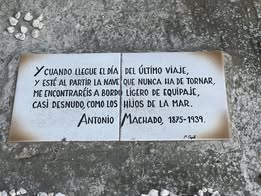
Epitaph

Epitafio

Antonio Machado (1875-1939)

At his grave in Collioure
Epitafio
Y cuando llegue el día del último viaje, Y esté al partir el nave que nunca ha de tornar, Me encontraréis a bordo ligero de equipaje, Casí desnudo, como los hijos de la mar.
Epitaph
"And when the day comes for the final voyage, The ship of no return shall leave the quay, You’ll find me gone aboard with not much baggage, Near naked, as the sons of the sea."

Translation: Copyright © Timothy Adès

More poems by Antonio Machado...

Le Cid

Le Cid

GEORGES FOUREST (1867-1945)

Le Cid
Le palais de Gormaz, comte et gobernador, est en deuil : pour jamais dort couché sous la pierre l'hidalgo dont le sang a rougi la rapière de Rodrigue appelé le Cid Campeador. Le soir tombe. Invoquant les deux saints Paul et Pierre Chimène, en voile noire, s'accoude au mirador et ses yeux dont les pleurs ont brûlé la paupière regarde, sans rien voir, mourir le soleil d'or... Mais un éclair, soudain, fulgure en sa prunelle : sur la plaza Rodrigue est debout devant elle ! Impassible et hautain, drapé dans sa capa, le héros meurtrier à pas lents se promène : - Dieu! soupire à part soi la plaintive Chimène, qu'il est joli garçon l'assassin de Papa !
Le Cid
There is death at Count Gormaz the Governor’s hall: beneath the cold capstone for ever is laid the hidalgo whose blood has just reddened the blade of Rodrigo the Cid, greatest champ of them all. Black-draped on the mirador – evening must fall – Chimène is entreating Saints Peter and Paul. Her eyes are all fiery with tears as she prays: she watches, unseeing, the last golden rays. But suddenly lightning has flashed in her face! In his cape in the plaza below her he stands, impassive and haughty, with blood on his hands! The hero goes strolling at moderate pace, and Chimène turns aside to sigh wistfully, “La! What a good-looking fellow has butchered papa!”

Translation: Copyright © Timothy Adès

More poems by GEORGES FOUREST...

Fantasio

Categories
French

Fantasio

André Bellessort (1866-1942)

La mort t'ayant surpris en travesti de bal, Pauvre Fantasio, de folles jeunes filles Te firent un linceul de leurs blanches mantilles, Et tu fus enterré le soir du carnaval. Sous un léger brouillard du ciel occidental Le mardi gras folâtre éparpillait ses trilles, Et ton glas, voltigeant sur de lointains quadrilles, Détachait dans la nuit ses notes de cristal. Des coins du corbillard le feu des girandoles Éclairait tout un chœur d'étranges farandoles. Nul n'avait pris le temps de revêtir le deuil. Ta rieuse maîtresse avait gardé son masque Et tous faisaient jouer derrière ton cercueil Une marche funèbre à leurs tambours de basque.
Fantasio
Death caught you costumed for the fancy ball. Giddy young women (Poor Fantasio!) lent you their white mantillas for a pall: they buried you, that night of carnival. In the slight vapour of the western sky mad Mardi Gras went frittering its trills; Your death-knell pranced on faraway quadrilles, etched on the night its crystal threnody. The flames of candelabra round the bier lit dancers reeling in an eerie choir. No-one had paused to dress in mourning-gear. Your laughing mistress kept her mask, and all followed your corse and, played, Fantasio, on tambourines, a march funereal.

Translation: Copyright © Timothy Adès

More poems by André Bellessort...

Goldfinch in Jail

The Caged Goldfinch

Thomas Hardy (1840-1928)

The Caged Goldfinch
Within a churchyard, on a recent grave, I saw a little cage That jailed a goldfinch. All was silence save Its hops from stage to stage. There was inquiry in its wistful eye, And once it tried to sing; Of him or her who placed it there, and why, No one knew anything. True, a woman was found drowned the day ensuing, And some at times averred The grave to be her false one's, who when wooing Gave her the bird.
Goldfinch in Jail
Within a churchyard, on a just-laid plot, I saw a tiny jail: A goldfinch was within. No sound: but, what? Hop, hop, a dismal trail. Inquiry in its wistful look saw I; I saw it fail to sing; Of who had put it in that spot, and why, Folk didn't know a thing. But soon a woman in a brook was found, Spawning this common word: A traitor swain lay in that holy ground; His gift, that bird.

Translation: Copyright © Timothy Adès

More poems by Thomas Hardy...

Ending

Ausgang

Theodor Fontane (1819-98)

Ausgang
Immer enger, leise, leise Ziehen sich die Lebenskreise, Schwindet hin, was prahlt und prunkt, Schwindet hoffen, hassen, lieben, Und ist nichts in Sicht geblieben Als der letzte dunkle Punkt.
Ending
Ever tighter draw life’s coils, Gloss decays and glory spoils, Softly, softly, step by step: Hope and hate and love diminish, Nothing left to see: we finish With the final, dark full stop.

Translation: Copyright © Timothy Adès

More poems by Theodor Fontane...

The Bridge on the Tay

Die Brück am Tay

Theodor Fontane (1819-98)

Schottland 1879. Shakespeare Macbeth die drei Hexen.
Die Brück am Tay
"Wann treffen wir drei wieder zusamm′?" "Um die siebente Stund′, am Brückendamm." "Am Mittelpfeiler." "Ich lösche die Flamm′." "Ich mit." "Ich komme vom Norden her." "Und ich von Süden." "Und ich vom Meer." "Hei, das gibt ein Ringelreihn, Und die Brücke muss in den Grund hinein." "Und der Zug, der in die Brücke tritt Um die siebente Stund′?" "Ei der muß mit." "Muß mit." "Tand, Tand, Ist das Gebilde von Menschenhand." Auf der Norderseite, das Brückenhaus - Alle Fenster sehen nach Süden aus, Und die Brücknersleut′, ohne Rast und Ruh Und in Bangen sehen nach Süden zu, Sehen und warten, ob nicht ein Licht Übers Wasser hin "ich komme" spricht, "Ich komme, trotz Nacht und Sturmesflug, Ich, der Edinburger Zug." Und der Brückner jetzt: "Ich seh einen Schein Am anderen Ufer. Das muß er sein. Nun Mutter, weg mit dem bangen Traum, Unser Johnie kommt und will seinen Baum, Und was noch am Baume von Lichtern ist, Zünd′ alles an wie zum heiligen Christ, Der will heuer zweimal mit uns sein, - Und in elf Minuten ist er herein." Und es war der Zug. Am Süderturm Keucht er vorbei jetzt gegen den Sturm, Und Johnie spricht: "Die Brücke noch! Aber was tut es, wir zwingen es doch. Ein fester Kessel, ein doppelter Dampf, Die bleiben Sieger in solchem Kampf, Und wie′s auch rast und ringt und rennt, Wir kriegen es unter: das Element." "Und unser Stolz ist unsre Brück′; Ich lache, denk ich an früher zurück, An all den Jammer und all die Not Mit dem elend alten Schifferboot; Wie manche liebe Christfestnacht Hab ich im Fährhaus zugebracht, Und sah unsrer Fenster lichten Schein, Und zählte, und konnte nicht drüben sein." Auf der Norderseite, das Brückenhaus - Alle Fenster sehen nach Süden aus, Und die Brücknersleut′ ohne Rast und Ruh Und in Bangen sehen nach Süden zu; Denn wütender wurde der Winde Spiel, Und jetzt, als ob Feuer vom Himmel fiel′, Erglüht es in niederschießender Pracht Überm Wasser unten … Und wieder ist Nacht. "Wann treffen wir drei wieder zusamm′?" "Um Mitternacht, am Bergeskamm." "Auf dem hohen Moor, am Erlenstamm." "Ich komme." "Ich mit." "Ich nenn euch die Zahl." "Und ich die Namen." "Und ich die Qual." "Hei! Wie Splitter brach das Gebälk entzwei." "Tand, Tand, Ist das Gebilde von Menschenhand."
The Bridge on the Tay
"When shall we three meet again?" "At the seventh hour, at the bridge's dam." "At the middle pier." "I shall quench the flame." "And so shall I." "From the North I’ll come." "From the South I’ll come." “And I from the foam." "Ho, it shall be a ring-around. And the bridge shall sink, shall sink to the ground." "And the train on the bridge, at the seventh hour?" “That too shall be drowned.” “That too shall be drowned.” “Baubles vain, Such is the handiwork of man!” In the bridge house on the northern side The windows look south, and the folk inside anxiously, restlessly, southward gaze, waiting and watching, whether a light over the water speaks amain braving the dark and stormy night: ‘From Edinburgh coming, ’tis I, the train.’ And the bridgeman speaks: “A light I see on the further bank. The train it must be. Now, Mother, an end to your brooding drear, our Jock is coming, he wants his tree, so light every light on the Christmas fir as if for the Christ our Saviour dear. He will come twice for us this year, and in twelve minutes' time he shall be here." And the train was passing the southern tower, straining against the tempest’s power. “Only the bridge,” says Jock. “What then? Tight-wrought boiler, full head of steam, into battle, an unconquered team! For all it may wrestle and rage and rant, we yet shall master the element. “Our bridge is our pride. I recall and laugh, when I think of old times and of all the grief and all the distress with the poor old skiff: how many times past at Christmastide in the ferryman’s house I’ve had to bide and I gazed at our windows’ merry glare and counted the hours and couldn’t be there.” In the bridge house on the northern side the windows look south, and the folk inside anxiously, restlessly, southward gaze, as ever more furious the wild wind plays… And hurtling from heaven a fearsome blaze, a fiery thunderbolt, blinding bright, embroils the water! …Again it is night. “When shall we three meet again?” “At midnight, on the mountain-comb.” “By the alder-stump on the lofty plain.” “I’ll come.” “And I’ll come.” “The number I’ll name.” “I’ll tell every name.” “I’ll tell the pain.” “Ho, how it splintered and split, the span.” “Baubles vain, Such is the handiwork of man!”

Translation: Copyright © Timothy Adès

More poems by Theodor Fontane...

Sonnet - Epitaph

Sonnet - Épitaphe

Gérard de Nerval (1808-55)

Sonnet - Épitaphe
Il a vécu tantôt gai comme un sansonnet, Tour à tour amoureux insoucieux et tendre, Tantôt sombre et rêveur comme un triste Clitandre. Un jour il entendit qu'à sa porte on sonnait. C'était la Mort ! Alors il la pria d'attendre Qu'il eût posé le point à son dernier sonnet ; Et puis sans s'émouvoir, il s'en alla s'étendre Au fond du coffre froid où son corps frissonnait. Il était paresseux, à ce que dit l'histoire, Il laissait trop sécher l'encre dans l'écritoire. Il voulait tout savoir mais il n'a rien connu. Et quand vint le moment où, las de cette vie, Un soir d'hiver, enfin l'âme lui fut ravie, Il s'en alla disant : " Pourquoi suis-je venu ? "
Sonnet - Epitaph
At times he seemed a skylark, gaily singing, A lover, now insouciant, now tender, At times a dreamer like a sad Clitander, Until one day he heard his doorbell ringing. The visitor was Death He bade him wait For one last sonnet, yet to be delivered. And then he went and lay, dispassionate, In the cold coffin, where his body shivered. An idler – such was history’s reckoning – He let his ink run dry, his pen fall dumb, Wished for all knowledge, didn’t know one thing. One winter night, tired of life’s tedium, His time was up, his soul was on the wing. He went, and said: ‘Why ever did I come?’

Translation: Copyright © Timothy Adès

More poems by Gérard de Nerval...

His Daughter’s Grave

Demain, dès l'aube

Victor Hugo (1802-85)

His daughter Léopoldine had died at age 19 in a boating accident, with her husband who tried to save her.
Demain, dès l'aube
Demain, dès l’aube, à l’heure où blanchit la campagne, Je partirai. Vois–tu, je sais que tu m’attends. J’irai par la forêt, j’irai par la montagne. Je ne puis demeurer loin de toi plus longtemps. Je marcherai les yeux fixés sur mes pensées, Sans rien voir au dehors, sans entendre aucun bruit, Seul, inconnu, le dos courbé, les mains croisées, Triste, et le jour pour moi sera comme la nuit. Je ne regarderai ni l’or du soir qui tombe, Ni les voiles au loin descendant vers Harfleur, Et quand j’arriverai, je mettrai sur ta tombe Un bouquet de houx vert et de bruyère en fleur.
His Daughter’s Grave
Tomorrow, soon as dawn has lit the land, I’ll start. I know you’re waiting there, you see. I’ll walk the woods and hills. I cannot stand Another day, having you far from me. My eyes will fasten on my thoughts. I’ll tread, Hearing no voice, seeing no outward sight, Nameless, alone, hands folded, lowered head, In sadness: and my day shall be as night. I shall not watch the falling gold of eve, The distant sails borne down towards Harfleur. I’ll come and lay my tribute on your grave: Green holly, gathered tight with ling in flower.

Translation: Copyright © Timothy Adès

More poems by Victor Hugo...

A Setting Free

La mise en liberté

Victor Hugo (1802-85)

La mise en liberté
Après ce rude hiver, un seul oiseau restait Dans la cage où jadis tout un monde chantait. Le vide s'était fait dans la grande volière. Une douce mésange, autrefois familière, Était là seule avec ses souvenirs d'oiseau. N'être jamais sans grain, sans biscuit et sans eau, Voir entrer quelquefois dans sa cage une mouche, C'était tout son bonheur. Elle en était farouche. Rien, pas même un serin, et pas même un pierrot. La cage, c'est beaucoup ; mais le désert, c'est trop. Triste oiseau ! dormir seul, et, quand l'aube s'allume, Être seul à fouiller de son bec sous sa plume ! Le pauvre petit être était redevenu Sauvage, à faire ainsi tourner ce perchoir nu. Il semblait par moments s'être donné la tâche De grimper d'un bâton à l'autre sans relâche ; Son vol paraissait fou ; puis soudain le reclus Se taisait, et, caché, morne, ne bougeait plus. À voir son gonflement lugubre, sa prunelle, Et sa tête ployée en plein jour sous son aile, On devinait son deuil, son veuvage, et l'ennui Du joyeux chant de tous dans l'ombre évanoui. Ce matin j'ai poussé la porte de la cage. J'y suis entré. Deux mâts, une grotte, un bocage, Meublent cette prison où frissonne un jet d'eau ; Et l'hiver on la couvre avec un grand rideau. Le pauvre oiseau, voyant entrer ce géant sombre, A pris la fuite en haut, puis en bas, cherchant l'ombre, Dans une anxiété d'inexprimable horreur ; L'effroi du faible est plein d'impuissante fureur ; Il voletait devant ma main épouvantable. Je suis, pour le saisir, monté sur une table. Alors, terrifié, vaincu, jetant des cris, Il est allé tomber dans un coin ; je l'ai pris. Contre le monstre immense, hélas, que peut l'atome ? À quoi bon résister quand l'énorme fantôme Vous tient, captif hagard, fragile et désarmé ? Il était dans mes doigts inerte, l'oeil fermé, Le bec ouvert, laissant pendre son cou débile, L'aile morte, muet, sans regard, immobile, Et je sentais bondir son petit cœur tremblant. Avril est de l'aurore un frère ressemblant ; Il est éblouissant ainsi qu'elle est vermeille. Il a l'air de quelqu'un qui rit et qui s'éveille. Or, nous sommes au mois d'avril, et mon gazon, Mon jardin, les jardins d'à côté, l'horizon, Tout, du ciel à la terre, est plein de cette joie Qui dans la fleur embaume et dans l'astre flamboie : Les ajoncs sont en fête, et dorent les ravins Où les abeilles font des murmures divins ; Penché sur les cressons, le myosotis goûte À la source, tombant dans les fleurs goutte à goutte ; Le brin d'herbe est heureux ; l'âcre hiver se dissout ; La nature parait contente d'avoir tout, Parfums, chansons, rayons, et d'être hospitalière. L'espace aime. Je suis sorti de la volière, Tenant toujours l'oiseau ; je me suis approché Du vieux balcon de bois par le lierre caché ; Ô renouveau ! Soleil ! tout palpite, tout vibre, Tout rayonne ; et j'ai dit, ouvrant la main : Sois libre ! L'oiseau s'est évadé dans les rameaux flottants, Et dans l'immensité splendide du printemps ; Et j'ai vu s'en aller au loin la petite âme Dans cette clarté rose où se mêle une flamme, Dans l'air profond, parmi les arbres infinis, Volant au vague appel des amours et des nids, Planant éperdument vers d'autres ailes blanches, Ne sachant quel palais choisir, courant aux branches, Aux fleurs, aux flots, aux bois fraîchement reverdis, Avec l'effarement d'entrer au paradis. Alors, dans la lumière et dans la transparence, Regardant cette faite et cette délivrance, Et ce pauvre être, ainsi disparu dans le port, Pensif, je me suis dit : Je viens d'être la mort.
A Setting Free
This winter so harsh had left only one bird In the cage where the songs of so many were heard. There’d been a clean sweep in the oversized rookery: A dear little blue-tit, once part of a family, Was in there alone: all the rest were a memory. With grain, rusks, and water in constant supply, To observe dropping in the occasional fly Was the whole of her joy: she was sullen and shy. She had not one canary, not even a sparrow. To be caged, bad enough; but to plough a lone furrow… Poor bird, lonely sleeper, constrained at bright dawn To plunge her beak under her feathers alone! The sad little creature was frantic, not tame, As she played with no partner the perch-spinning game; She would make you believe she had just undertaken To climb all the bars, in a sequence unbroken. She’d fly about madly, then suddenly stay Immobile and silent and hidden away. Her gloomy puffed plumage, her dimness of eye, Head under her wing with the sun in the sky, Made clear her bereavement, her mourning, her longing For the vanished, extinguished grand concert of singing. This morning I went to her door, gave a push, And stepped in. There’s a grotto, two poles and a bush, So the prison is furnished; a fountain is spurting; In winter we close it all up with a curtain. The bird saw the grim Brobdingnagian come: She flew high, she flew low, she dived down in the gloom, In the grip of unspeakable horror and panic: The funk of the weak is both futile and manic. She fluttered in front of my terrible hand; I was up on a table, a good place to stand. She, terrified, cowering, shrieking and shaking, Collapsed in a corner, all mine for the taking. When the behemoth lunges, what hope for the bantam? Can you fight, when the monster, the lumbering phantom, Has seized you, poor captive, wan, frail and defenceless? She lay in my fingers, unmoving and senseless, Eyes closed and beak open, the neck limply drooping, The wings lying lifeless, not seeing nor cheeping; I noticed her little heart trembling and leaping. April is the dawn’s twin brother: Bright the one and red the other. Ever laughing, ever wakeful Seems this present month of April: Everything, my lawn, my garden, All these gardens, that horizon, All in earth and sky rejoice: Perfumed flowers, flaming stars, Gullies gilt by festive furze, Heavenly murmuring of bees; Cress-beds’ myosotis sips Where the petalled water slips; Grass-blades glint, harsh winter thaws; Well-contented Nature has Scent, song, and sunshine, freely giving. Even empty space is loving. I took the bird from the aviary To the old, wooden, ivy-girt balcony. Renewal and sunlight and vibrancy! I opened my hand and I said ‘Go free’. The bird headed out to the branchy fastness And into spring’s magnificent vastness; And I watched it shrink in the sunny sky, In the airy depths’ rose-clarity; And it flew away to the endless trees, To the loves’ and the nests’ vague messages; To seek white wings it was soaring careless, Speeding to the branches to choose its palace, To pools, and petals, where the new leaves rise, Amazed to have entered into paradise. So I stood in the sunshine’s brilliant light And I watched the poor bird in its freedom-flight. I could see it was saved from its troubles below, And I thought: I was Death, just a moment ago.
Translation: Copyright © Timothy Adès

More poems by Victor Hugo...