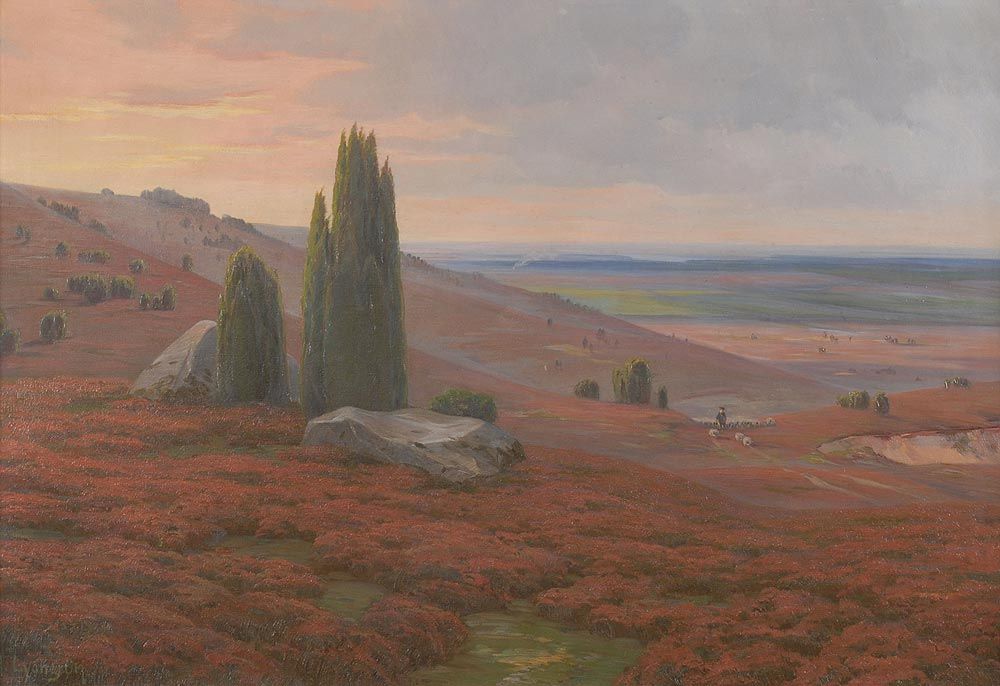
My Life

Mein Leben

Theodor Fontane (1819-98)

Mein Leben
Mein Leben, ein Leben ist es kaum, ich gehe dahin als wie im Traum. Wie Schatten huschen Menschen hin, ein Schatten dazwischen ich selber bin. Und im Herzen tiefe Müdigkeit. Alles sagt mir: Es ist Zeit ...
My Life
My life is hardly a life at all, As if in a dream I go my way. Like shadows, people scurry away, And I’m a shadow among them all. In my heart is a weariness, deepening. It’s time, it’s time, says everything.

Translation: Copyright © Timothy Adès

More poems by Theodor Fontane...

Elisabeth’s Song (from ‚Immensee‘)

Elisabeth

Theodor Storm (1817 –-88)

Elisabeth
Meine Mutter hat's gewollt, Den andern ich nehmen sollt; Was ich zuvor besessen, Mein Herz sollt es vergessen; Das hat es nicht gewollt. Meine Mutter klag ich an, Sie hat nicht wohlgetan; Was sonst in Ehren stünde, Nun ist es worden Sünde. Was fang ich an? Für all mein Stolz und Freud Gewonnen hab ich Leid. Ach, wär das nicht geschehen, Ach, könnt ich betteln gehen Über die braune Heid.
Elisabeth’s Song (from ‚Immensee‘)
That was her wish, my mother, That I should take the other. What I possessed before, Forget! And crave no more. But my heart disagreed: My mother let me down, She did me no good deed. I would have had my honour, But now I am a sinner. And how may I proceed? My joy and pride are gone: Sad sorrow have I won. Would it had not been so! Could I a-begging go Over the moorland brown!

Translation: Copyright © Timothy Adès

More poems by Theodor Storm...

April

April

Theodor Storm (1817 –-88)

April
Das ist die Drossel, die da schlägt, Der Frühling, der mein Herz bewegt; Ich fühle, die sich hold bezeigen, Die Geister aus der Erde steigen. Das Leben fließet wie ein Traum – Mir ist wie Blume, Blatt und Baum.
April
I hear the song-thrush chirruping, And lo! my heart is moved by spring. I feel illustrious entities, Spirits, from deepest earth arise. Like any flower, leaf, and tree, Life is a fleeting dream for me.

Translation: Copyright © Timothy Adès

More poems by Theodor Storm...

On Marriage

Ehespruch

Emanuel Geibel (1815-84)

Ehespruch
Das ist die rechte Ehe, wo zweie sind gemeint, durch alles Glück und Wehe zu pilgern treu vereint. Der eine Stab des andern, und liebe Last zugleich, gemeinsam Rast und Wandern, und Ziel das Himmelreich.
On Marriage
That is a proper marriage Where two are of one mind, Through all the joys and sorrows As pilgrims true combined. Each is the staff of the other, Each is the cherished load: They rest and range together, Set fair on heaven’s road.

Translation: Copyright © Timothy Adès

More poems by Emanuel Geibel...

Lyra Limerica

Limericks

Edward Lear (1812-88)

Limericks
BIRDS IN THE BEARD (published in CA News, December 2004) There was an Old Man with a beard, Who said, 'It is just as I feared! Two Owls and a Hen, Four Larks and a Wren, Have all built their nests in my beard!' CAPRICIOUS CAPERS published in CA News There was an Old Person of Ischia, Whose conduct grew friskier and friskier; He danced hornpipes and jigs, And ate thousands of figs, That lively Old Person of Ischia. DEFLATED published in CA News, said at Horatian Society There was an Old Man in a boat, Who said ‘I’m afloat! I’m afloat!’ When they said ‘No! you ain’t!’ He was ready to faint, That unhappy Old Man in a boat. TERRA FIRMA published in CA News There was a Young Lady of Portugal, Whose ideas were excessively nautical: She climbed up a tree, to examine the sea, But declared she would never leave Portugal. SHOE SHOCK Said at Horatian Society dinner There was an Old Man of the Wrekin Whose shoes made a horrible creaking; But they said ‘Tell us whether Your shoes are of leather, Or of what, you Old Man of the Wrekin?’ NONCHALANT There was a Young lady of Norway Who sat herself down in a doorway. When the door squashed her flat, She exclaimed ‘What of that?’ This courageous Young lady of Norway. TOO LONG BY HALF There was an old man of Coblenz, The length of whose legs was immense ; He went with one prance, from Turkey to France, That surprising old man of Coblenz. EASTERN PROMISE There was a young lady of Tyre, Who swept the loud chords of a lyre ; At the sound of each sweep, she enraptured the deep, And enchanted the city of Tyre. UNHEEDED There was an Old Man who said, "Well! Will nobody answer this bell? I have pulled day and night, till my hair has grown white, But nobody answers this bell!" DIRGE OF A SHREW There was an old person of Tartary Who divided his jugular artery. But he screeched to his wife, and she said »Oh, my life! Your death will be felt by all Tartary. » VULCAN’S STITHY published in CA News There was an Old Person of Gretna, Who rushed down the crater of Etna; When they said, ‘Is it hot?’ he replied, ‘No, it’s not!’ That mendacious Old Person of Gretna. ATHLETE’S FEAT There was a Young Girl of Majorca, Whose Aunt was a very fast walker; She walked seventy miles, and leaped fifteen stiles, Which astonished that Girl of Majorca. STRICT REGIMEN published in CA News There was an Old Person of Sparta Who had twenty-five sons and one daughter; He fed them on snails, and weighed them in scales, That wonderful person of Sparta. MAD COW There was an Old Man of Aôsta, Who possessed a large Cow, but he lost her; But they said, 'Don't you see, she has rushed up a tree? You invidious Old Man of Aôsta HONG KONG There was an old man of Hong Kong Who never did anything wrong. He lay on his back With his head in a sack, That innocuous old man of Hong Kong. DOOM WITH A VIEW There was an Old Person of Florence, Who held mutton chops in abhorrence; He purchased a Bustard, and fried ihm in Mustard, Which choked that Old Person of Florence, DISCOMBOBULATED CA News and Horatian Society There was an Old Person of Diss, Who said, ‘It is this! It is this!’ When they said, ‘What?’ or ‘Which?’ – He jumped into a ditch, Which absorbed that Old Person of Diss.
Lyra Limerica
* barbatus hospes nidificantium: ‘fit quod timebam! strix, trochilus, canens gallina cum bubone, alaudae quattuor, inseruere nidos.’ * lasciviores Inarimae, senex, misces choreas; innumerabiles mandis, Pithecusæe, ficus; fersque pedem numeris marinis. * ‘heus, nonne no? no! nat mea trabs,’ ait vir lintre vectus; praetereuntium cui turba: ‘tu non nas.’ recessit deficiens miserandum in alveum. * non Lusitanae mente cadunt maris naves; ut aequor spectet, in arborem conscendit. inde effata: ‘nunquam te, Tage, teque, Duri, relinquam.’ * raucis cothurnis improbe Cornovi, crepide crocis. ‘ num corio crepis? quonamve?’ sic horrent canoras carbatinas Viroconienses. * Septentrionum nubilis incola incauta portae sedit in ostio. elisa, ‘quidnam tum?’ vigore clamat Hyperboreos feroci. * immensa saltans ex Asia gradu imponit uno crura Parisiis, quem Rhenus eduxit Mosella compare sesquipedaliorem. * Phoenissa chordas raucisonas lyrae cum nympha magnis verreret ictibus, immane delectabat aequor et Tyriam recreabat urbem. * ‘longum sonanti num quis adest seni? canescit, inquam, caesaries mihi: pernoxque tinnitu vocavi perque diem: neque oboedit ullus.’ * qui Chersonesi se iugulaverat dat soricinas gutture nenias. cui sponsa: ‘vexabuntur omnes morte tua, mea vita, Tauri.’ * ex Hadriani moenibus advena cratera in Aetnae desilit irruens. ‘ardetne?’ ‘nequaquam.’ fefellit Scoticus Empedocles Sicanos. * tu dena vadis milia septies, ter quinque sepes tu superevolas, matertera, admiranda nepti: quin Baliaris hians stupescit. * o pasta proles fotaque cochleis! examinasti tu, pater, unicam post quinque vigintique natos, mire Lacon, trutina puellam. * Praetorianus possidet haud levem perditque vaccam. ‘nonne vides?’ ait vicinus, ‘ascendit comantes, invidiose, oneratque ramos.’ * urbs, a Britannis reddita Seribus! vir, purus omnis criminis improbi, velavit in sacco supinus innocuum caput, et recumbit. * non Arniensem lanigeri caro delectat agni. comparat otidem, quae fricta cum flavo sinapi fauce premit perimitque Tuscum. * Icenus, annis nempe senilibus marcens, ‘id hoc est’, inquit, ‘et hoc id est’. cum ‘quid? quod?’ aut ‘quod? quid?’ rogarent, desilit excipiturque fossa.

Translation: Copyright © Timothy Adès

More poems by Edward Lear...

I Said to my Heart

J'ai dit à mon coeur

ALFRED DE MUSSET (1810-57)

J'ai dit à mon coeur
J'ai dit à mon cœur, à mon faible cœur : N'est-ce point assez d'aimer sa maîtresse ? Et ne vois-tu pas que changer sans cesse, C'est perdre en désirs le temps du bonheur ? Il m'a répondu : Ce n'est point assez, Ce n'est point assez d'aimer sa maîtresse ; Et ne vois-tu pas que changer sans cesse Nous rend doux et chers les plaisirs passés ? J'ai dit à mon cœur, à mon faible cœur : N'est-ce point assez de tant de tristesse ? Et ne vois-tu pas que changer sans cesse, C'est à chaque pas trouver la douleur ? Il m'a répondu : Ce n'est point assez, Ce n'est point assez de tant de tristesse ; Et ne vois-tu pas que changer sans cesse Nous rend doux et chers les chagrins passés ?
I Said to my Heart
I said to my heart, my heart so weak, ‘Is it not enough to love one’s mistress, And do you not see, when change is ceaseless, We lose in yearning the bliss we seek ? It is not enough,’ said my heart so weak, It is not enough to love one’s mistress, And do you not see, when change is ceaseless, Past joys are made sweeter and mild and meek ? I said to my heart, my heart so weak, Is it not enough to have so much sadness, And do you not see, when change is ceaseless, Our sorrow is new, every day of the week? It is not enough,’ said my heart so weak, It is not enough to have so much sadness, And do you not see, when change is ceaseless, Past griefs are made sweeter and mild and meek.’
A jazz version, an urgent version, a thoughtful version...

Translation: Copyright © Timothy Adès

More poems by ALFRED DE MUSSET...

Quercus

The Oak

Alfred, Lord Tennyson (1809-92)

His English, my Latin
The Oak
Live thy Life, Young and old, Like yon oak, Bright in spring, Living gold; Summer-rich Then; and then Autumn-changed Soberer-hued Gold again. All his leaves Fall'n at length, Look, he stands, Trunk and bough Naked strength.
Quercus
vive prout quercus iuvenisque senexque propinqua: aurea uti quercus tu quoque vere nite, aestiva locuples, autumna fronde minori, aurea tranquillo rite colore novo. denique nudata est foliis, en robore rami stant nudo, nudo robore truncus item.

Translation: Copyright © Timothy Adès

More poems by Alfred, Lord Tennyson...

In the Luxembourg Gardens

Une Allée du Luxembourg

Gérard de Nerval (1808-55)

Une Allée du Luxembourg
Elle a passé, la jeune fille Vive et preste comme un oiseau : À la main une fleur qui brille, À la bouche un refrain nouveau. C’est peut-être la seule au monde Dont le cœur au mien répondrait, Qui venant dans ma nuit profonde D’un seul regard l’éclaircirait ! Mais non, – ma jeunesse est finie... Adieu, doux rayon qui m’as lui, – Parfum, jeune fille, harmonie... Le bonheur passait, – il a fui !
In the Luxembourg Gardens
She passed by, she was young, Lithe as bird on the wing, In her hand a bright flower, On her lips a new song. Could her heart, of all hearts, Give my heart a response? Could she lighten my dark With the fire of her glance? But no, my youth is finished... Farewell, sweet ray that shone, Girl, music, perfume, vanished: Happiness, passing, gone ! And here's a translation by Anon: E’ passata la gaia ragazza, svelta e vispa come un fringuello: con in mano una rosa di guazza, ed in bocca un suo fresco stornello. Ella è forse la sola nel mondo che darebbe il suo cuore al mio cuore: e che il buio in cui vivo, profondo, con un bacio farebbe splendore. Ma la mia giovinezza è già via… Ti saluto, miraggio fugace! Oh! Profumo, fanciulla, armonia, non son più che un ricordo mendace.
'Ivann', singer-songwriter: https://www.youtube.com/watch?v=eZTV62LuYow

Translation: Copyright © Timothy Adès

More poems by Gérard de Nerval...

Fantasy

Fantaisie

Gérard de Nerval (1808-55)

Fantaisie
Il est un air pour qui je donnerais Tout Rossini, tout Mozart et tout Wèbre : Un air très vieux, languissant et funèbre, Qui pour moi seul a des charmes secrets! Or, chaque fois que je viens à l’entendre, De deux cents ans mon âme rajeunit... C’est sous Louis treize; et je crois voir s’étendre Un coteau vert, que le couchant jaunit. Puis un château de brique à coins de pierre, Aux vitraux teints de rougeâtres couleurs, Ceint de grands parcs, avec une rivière Baignant ses pieds, qui coule entre des fleurs; Puis une dame, à sa haute fenêtre, Blonde aux yeux noirs, en ses habits anciens, Que, dans une autre existence peut-être, J’ai déjà vue... et dont je me souviens!
Fantasy
Rossini, Mozart, yes, and Weber, I’d give them all for just one tune: It’s ancient, languid and sepulchral, It keeps its charms for me alone. I hear it, and my soul is younger: Each time, two centuries are gone. Louis the Thirteenth; a green hillside Turns golden in the setting sun. Stately brick house with fine stone corners: Red colours tint its window-glass. A river laves its feet, goes flowing Through parks in flower, swathes of grass; Fair lady at her lofty window, Black eyes, her dress historical, Whom in some earlier existence I may have seen ... and can recall!

Translation: Copyright © Timothy Adès

More poems by Gérard de Nerval...

Notre-Dame, Paris

Notre-Dame de Paris

Gérard de Nerval (1808-55)

Notre-Dame de Paris
Notre-Dame est bien vieille: on la verra peut-être Enterrer cependant Paris qu’elle a vu naître; Mais, dans quelque mille ans, le Temps fera broncher Comme un loup fait un bœuf, cette carcasse lourde, Tordra ses nerfs de fer, et puis d’une dent sourde Rongera tristement ses vieux os de rocher! Bien des hommes, de tous les pays de la terre Viendront, pour contempler cette ruine austère, Rêveurs, et relisant le livre de Victor; – Alors ils croiront voir la vieille basilique, Toute ainsi qu’elle était, puissante et magnifique, Se lever devant eux comme l’ombre d’un mort!
Notre-Dame, Paris
Notre-Dame’s old. Who knows if, by and by, She, who saw Paris born, shall see her die? Ages shall pass. Time, as the wolf subdues The ox, shall bring her heavy carcass down With his dull tooth, shall twist her iron thews, And gnaw her skeleton of ancient stone. From every land on earth a throng shall stream To view the dismal ruin, and shall dream, Reading the fable that great Victor made: They’ll see a vision of the hallowed pile, Mighty and splendid in its antique style, Rise up before them like a spectral shade!
Published in Festschrift for Patricia Oxley

Translation: Copyright © Timothy Adès

More poems by Gérard de Nerval...