Springtime will return

Le printemps reviendra

Maurice Carême (1899-1978)

Le printemps reviendra
Hé oui, je sais bien qu'il fait froid, Que le ciel est tout de travers ; Je sais que ni la primevère Ni l'agneau ne sont encore là. La terre tourne ; il reviendra, Le printemps, sur son cheval vert. Que ferait le bois sans pivert, Le petit jardin sans lilas ? Oui, tout passe, même l'hiver, Je le sais par mon petit doigt Que je garde toujours en l'air …
Springtime will return
Yes, I know we have cold weather, And the sky is not playing fair; And I know that at present, neither The lamb nor the primrose is there. The world will turn, and the springtime Will return, astride its green mare. No woodpecker, what’ll the wood do? The garden, with no syringa? All things must pass, even winter: I know, by my little pink finger That’s always up in the air…

Translation: Copyright © Timothy Adès

More poems by Maurice Carême...

May

Der Mai

Erich Kästner (1899-1974)

Der Mai
Im Galarock des heiteren Verschwenders, ein Blumenzepter in der schmalen Hand, fährt nun der Mai, der Mozart des Kalenders, aus seiner Kutsche grüßend, über Land. Es überblüht sich, er braucht nur zu winken. Er winkt! Und rollt durch einen Farbenhain. Blaumeisen flattern ihm voraus und Finken. Und Pfauenaugen flügeln hinterdrein. Die Apfelbäume hinterm Zaun erröten. Die Birken machen einen grünen Knicks. Die Drosseln spielen, auf ganz kleinen Flöten, das Scherzo aus der Symphonie des Glücks. Die Kutsche rollt durch atmende Pastelle. Wir ziehn den Hut. Die Kutsche rollt vorbei. Die Zeit versinkt in einer Fliederwelle. O, gäb es doch ein Jahr aus lauter Mai! Melancholie und Freude sind wohl Schwestern. Und aus den Zweigen fällt verblühter Schnee. Mit jedem Pulsschlag wird aus Heute Gestern. Auch Glück kann weh tun. Auch der Mai tut weh. Er nickt uns zu und ruft: „Ich komm ja wieder!“ Aus Himmelblau wird langsam Abendgold. Er grüßt die Hügel, und er winkt dem Flieder. Er lächelt. Lächelt. Und die Kutsche rollt.
May
GLAD RAGS adorn this big and merry spender; A flower sceptre fills his gentle hand. This Mozart of (in German) the ‘KaLENder’ Spreads greetings from his coach across the land. A glut of blooms! He waves, that’s all he’s needing: He waves, and rolls through groves of every hue, Fluttering finches, bluetits too, preceding, Then peacock butterflies: his retinue. Green birch-trees dip their boughs and bow and curtsey, Apple-trees at the fence blush tints of rose. A Scherzo penned by Bliss, with other Scherzi, Is played by thrushes on their piccolos. This art’s alive and breathing, beyond lifelike: We raise our hat. The coach rolls on its way. Time is sucked under in a wave of lilac. O for a year of nothing else but May! Melancholy and ecstasy are sisters, And faded blossoms fall from boughs, like snow. Each heartbeat fashions yesterdays from this-days. And happiness can hurt. May too, you know. ‘I’m back! I’m here!’ he cries. He’s welcoming us! The gold of eve replaces heaven’s blue. He greets the hills, he nods to the syringas, He smiles and smiles. The coach goes rolling through.

Translation: Copyright © Timothy Adès

More poems by Erich Kästner...

Qasida of the Rose

Casida de la rosa

Federico García Lorca (1898-1936)

Casida de la rosa
La rosa no buscaba la aurora: casi eterna en su ramo, buscaba otra cosa. La rosa, no buscaba ni ciencia ni sombra: confín de carne y sueño, buscaba otra cosa. La rosa, no buscaba la rosa. Inmóvil por el cielo buscaba otra cosa.
Qasida of the Rose
The rose sought not the new day: on its stem it shall stay, it sought none of those. The rose sought not shadow nor study: between sleep and body, it sought none of those. The rose sought not for the rose: unmoving in heaven, it sought none of those.

Translation: Copyright © Timothy Adès

More poems by Federico García Lorca...

First Roses Woke

Erste Rosen erwachen

Rainer Maria Rilke (1875-1926)

Erste Rosen erwachen
Erste Rosen erwachen, und ihr Duften ist zag wie ein leisleises Lachen; flüchtig mit schwalbenflachen Flügeln streift es den Tag; und wohin du langst, da ist alles noch Angst. Jeder Schimmer ist scheu, und kein Klang ist noch zahm, und die Nacht ist zu neu, und die Schönheit ist Scham.
First Roses Woke
First roses woke, faintly they waft, laughter so soft, swift-winged, to stroke, gentling, the day. Where you would tread, still there is dread. Glimmers take fright, sounds are untamed, new is the night, beauty’s ashamed.

Translation: Copyright © Timothy Adès

More poems by Rainer Maria Rilke...

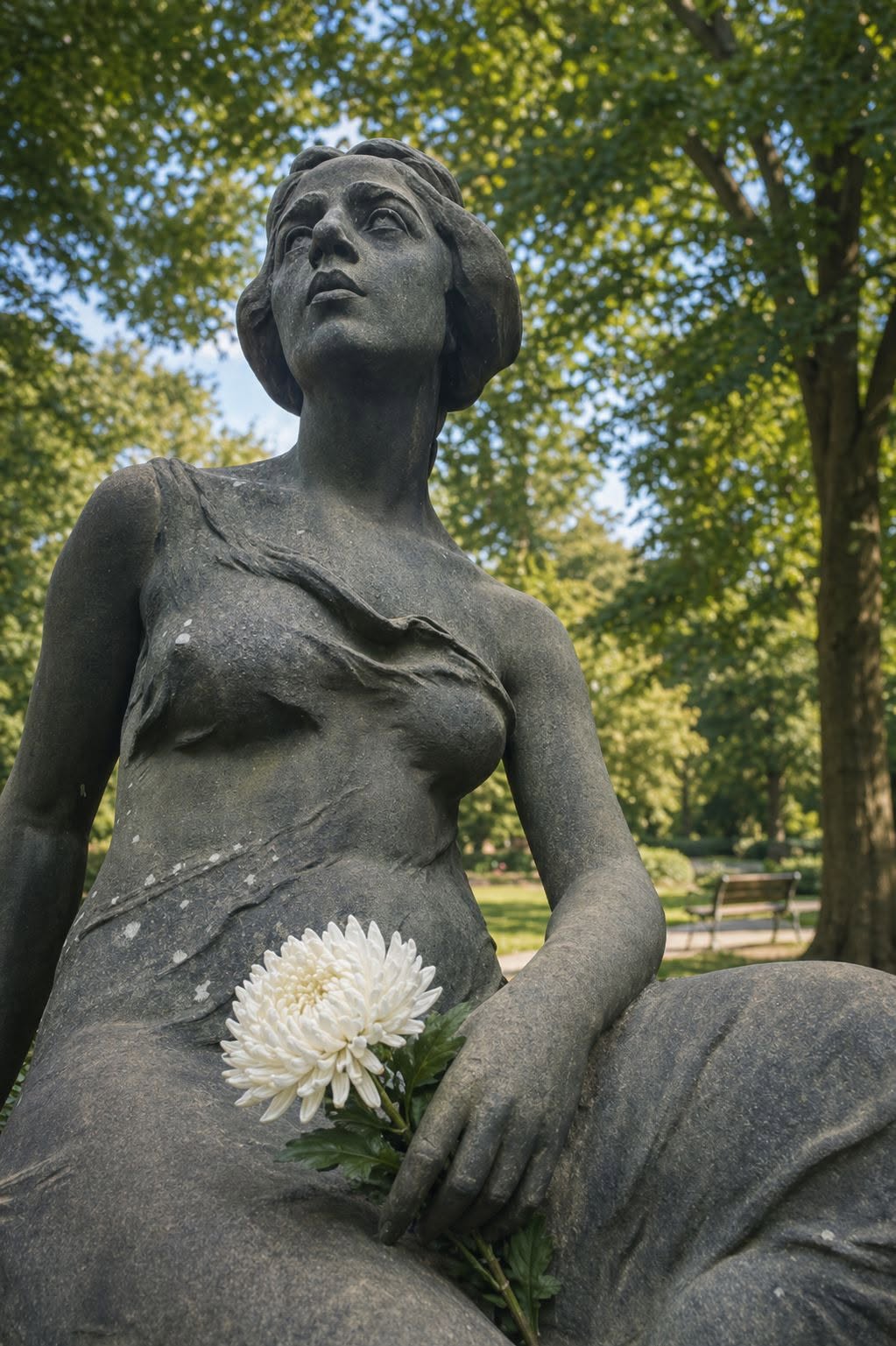
White Chrysanthemums

Weiße Chrysanthemen

Rainer Maria Rilke (1875-1926)

Weiße Chrysanthemen
Das war der Tag der weißen Chrysanthemen, mir bangte fast vor seiner schweren Pracht. Und dann, dann kamst du mir die Seele nehmen, tief in der Nacht. Mir war so bang, und du kamst lieb und leise, - ich hatte grad im Traum an dich gedacht. Du kamst, und leis wie eine Märchenweise erklang die Nacht.
White Chrysanthemums
All those chrysanthemums that day were white: their heavy splendour brought me close to grief. And then you came and took my soul, a thief at dead of night. So close… Softly you came then, my delight: My thoughts had dwelt upon you, as I dreamed. Softly you came, and fairy music seemed to fill the night.
Music: Alban Berg / Jessye Norman and Hans von Bülow / Petra Lang

Translation: Copyright © Timothy Adès

More poems by Rainer Maria Rilke...

Green

Green

Paul Verlaine (1844-96)

After deserting his wife for Rimbaud, wounding Rimbaud, released from prison: he writes to his wife...
Green
Voici des fruits, des fleurs, des feuilles et des branches Et puis voici mon coeur qui ne bat que pour vous. Ne le déchirez pas avec vos deux mains blanches Et qu'à vos yeux si beaux l'humble présent soit doux. J'arrive tout couvert encore de rosée Que le vent du matin vient glacer à mon front. Souffrez que ma fatigue à vos pieds reposée Rêve des chers instants qui la délasseront. Sur votre jeune sein laissez rouler ma tête Toute sonore encore de vos derniers baisers ; Laissez-la s'apaiser de la bonne tempête, Et que je dorme un peu puisque vous reposez.
Green
Here are fruits and flowers, here are leaves and fronds And here is my heart, only you can make it beat. Don’t tear it to pieces with your two white hands! To your beautiful eyes may this humble gift be sweet. I come before you still all covered with dew That was frozen on my brow by the morning breeze. I lay my fatigue at your feet, in the hope that you Will permit it to dream of imminent remedies. Allow my head to loll on your youthful breast, Still ringing with your kisses when they are strewn; Let it find peace when the pleasant storm is done, Let me sleep awhile, for you will be taking your rest.
Copyright © Timothy Adès Debussy, Hahn, Fauré : Teresa Stich-Randall, soprane: https://www.youtube.com/watch?v=CqFhD9vuZQA Fauré : Gérard Souzay : https://www.youtube.com/watch?v=ZDzdzjIFiqg Léo Ferré : https://www.youtube.com/watch?v=biy9NwOzz64 Julos Beaucarne : http://mimiclectik.canalblog.com/archives/2018/02/14/36117763.html

Translation: Copyright © Timothy Adès

More poems by Paul Verlaine...

Ver hiemem indagat...

When the Hounds of Spring Are on Winter's Traces

Algernon Swinburne (1837-1909)

Latin by Timothy Adès
When the Hounds of Spring Are on Winter's Traces
💜When the hounds of spring are on winter's traces,       The mother of months in meadow or plain Fills the shadows and windy places       With lisp of leaves and ripple of rain; And the brown bright nightingale amorous Is half assuaged for Itylus, For the Thracian ships and the foreign faces,       The tongueless vigil, and all the pain. 💜Come with bows bent and with emptying of quivers,       Maiden most perfect, lady of light, With a noise of winds and many rivers,       With a clamor of waters, and with might; Bind on thy sandals, O thou most fleet, Over the splendor and speed of thy feet; For the faint east quickens, the wan west shivers,       Round the feet of the day and the feet of the night. 💜Where shall we find her, how shall we sing to her,       Fold our hands round her knees, and cling? O that man's heart were as fire and could spring to her,       Fire, or the strength of the streams that spring! For the stars and the winds are unto her As raiment, as songs of the harp-player; For the risen stars and the fallen cling to her,       And the southwest wind and the west wind sing. 💜For winter's rains and ruins are over,       And all the season of snows and sins; The days dividing lover and lover,       The light that loses, the night that wins; And time remembered is grief forgotten, And frosts are slain and flowers begotten, And in green underwood and cover       Blossom by blossom the spring begins. 💜The full streams feed on flower of rushes,       Ripe grasses trammel a traveling foot, The faint fresh flame of the young year flushes       From leaf to flower and flower to fruit; And fruit and leaf are as gold and fire, And the oat is heard above the lyre, And the hoofed heel of a satyr crushes       The chestnut-husk at the chestnut-root. 💜And Pan by noon and Bacchus by night,       Fleeter of foot than the fleet-foot kid, Follows with dancing and fills with delight       The Maenad and the Bassarid; And soft as lips that laugh and hide The laughing leaves of the trees divide, And screen from seeing and leave in sight       The god pursuing, the maiden hid. 💜The ivy falls with the Bacchanal's hair       Over her eyebrows hiding her eyes; The wild vine slipping down leaves bare       Her bright breast shortening into sighs; The wild vine slips with the weight of its leaves, But the berried ivy catches and cleaves To the limbs that glitter, the feet that scare       The wolf that follows, the fawn that flies.
Ver hiemem indagat...
ver hiemem indagat: latrans vestigia pellit: ~~ nutrit prata Ceres et novus annus agros: murmura crebrescunt pluviae frondisque susurri, ~~ dum repleant tenebras aeriosque locos: fuscaque rursus amans minuit Philomela dolorem, ~~ clara nitens, neque Ityn iam velut ante gemit: mente cadunt Thressae naves et barbara turba ~~ et quantus vigili lingua resecta dolor. at venias, virgo sanctissima, lucis origo: ~~ tende ferox arcum: prompta sagitta micet! detque sonum surgens multo cum flumine ventus: ~~ detque sonum raucae vis resonantis aquae. indue tu soleas, o velocissima cursu: ~~ ornetur rapidi splendida forma pedis: nam veniente die veniente et nocte tremescit ~~ pallidus, en! Zephyrus, regna et Eoa nitent. queis quaerenda locis numerisve adfanda puella est? ~~ haereat apprendens qua manus arte genu ? o si cor nostrum saliens ceu flamma salutet, ~~ flamma, vel exortae mobile robur aquae ! sidera enim et venti sunt illi talis amictus, ~~ psallentem fertur qui decorasse Linum : illam oriens sidus, delapsum amplectitur illam : ~~ Africus Orpheos dat Zephyrusque sonos. nam sat hiems dederat stragis : iam desiit imber: ~~ diffugere nives: tollitur omne nefas : iam perit et tempus quod amantibus abdit amantes, ~~ quod noctes auget deminuitque dies. iam est memor horarum, maeroris et immemor, idem: ~~ confectum nascens flos fugat acre gelu: iam virgulta virent, frondescunt germina gemmis : ~~ verna sub arbustis incipit ipsa dies. crescit arundinibus pinguis cum floribus amnis: ~~ gramen opimum obstat, quin vetat ire pedem : vix rubet igne novo tener annus, et impiger heres ~~ flos folio, flori denique fructus adest : fructusque et folium splendent velut ignis et aurum, ~~ rustica dum cultam vincit avena lyram, cornipedi et Satyrus contundit calce sub umbra ~~ castaneam siliquam castaneamque nucem. et pede Pan rapido – non acrior haedus eundo! – ~~ tuve movens noctu, Liber, ut ille die, saltibus exagitans mirabilibusque choreis ~~ Maenadas oblectas Bassaridumque comas : et, ceu dissiliunr risu mollita labella, ~~ arboreae molles dissiluere comae : nec latet ille sequens Bacchantem divus amandam, ~~ nec patet adsiduo tecta puella deo. delapsi crines, hedera et delapsa puellae : ~~ cumque superciliis lumina clara latent: labitur et vitis: pectus nudatur anhelum : ~~ occultant nitidum tegmina nulla sinum. sub pede procumbunt oneroso palmite vites: ~~ ipsa hedera haere nti baccare membra capit, membra corusca et turbantes animalia plantas, ~~ seu lupus insequitur, seu cita cerva fugit.
For Swinburne as translator, see Victor Hugo, 'Penniless Children'

Translation: Copyright © Timothy Adès

More poems by Algernon Swinburne...

His Daughter’s Grave

Demain, dès l'aube

Victor Hugo (1802-85)

His daughter Léopoldine had died at age 19 in a boating accident, with her husband who tried to save her.
Demain, dès l'aube
Demain, dès l’aube, à l’heure où blanchit la campagne, Je partirai. Vois–tu, je sais que tu m’attends. J’irai par la forêt, j’irai par la montagne. Je ne puis demeurer loin de toi plus longtemps. Je marcherai les yeux fixés sur mes pensées, Sans rien voir au dehors, sans entendre aucun bruit, Seul, inconnu, le dos courbé, les mains croisées, Triste, et le jour pour moi sera comme la nuit. Je ne regarderai ni l’or du soir qui tombe, Ni les voiles au loin descendant vers Harfleur, Et quand j’arriverai, je mettrai sur ta tombe Un bouquet de houx vert et de bruyère en fleur.
His Daughter’s Grave
Tomorrow, soon as dawn has lit the land, I’ll start. I know you’re waiting there, you see. I’ll walk the woods and hills. I cannot stand Another day, having you far from me. My eyes will fasten on my thoughts. I’ll tread, Hearing no voice, seeing no outward sight, Nameless, alone, hands folded, lowered head, In sadness: and my day shall be as night. I shall not watch the falling gold of eve, The distant sails borne down towards Harfleur. I’ll come and lay my tribute on your grave: Green holly, gathered tight with ling in flower.

Translation: Copyright © Timothy Adès

More poems by Victor Hugo...

My Two Daughters

Mes deux filles

Victor Hugo (1802-85)

Les deux filles de VICTOR HUGO : deux tragédies : l’une est morte en pleine jeunesse, l’autre en vieillesse, longtemps enfermée dans l’asile. Voici un poème de bonheur, mais dont la date indique que la plus grande douleur est proche. Recueil : Les Contemplations. ‘La Terrasse, près d’Enghien, juin 1842’. Léopoldine vivante 1824-1843, Adèle 1830-1915. Au cinéma, ‘Lhistoire d’Adèle’, belle œuvre de François Truffaut avec Isabelle Adjani.
Mes deux filles
Dans le frais clair-obscur du soir charmant qui tombe, L'une pareille au cygne et l'autre à la colombe, Belle, et toutes deux joyeuses, ô douceur ! Voyez, la grande soeur et la petite soeur Sont assises au seuil du jardin, et sur elles Un bouquet d'oeillets blancs aux longues tiges frêles, Dans une urne de marbre agité par le vent, Se penche, et les regarde, immobile et vivant, Et frissonne dans l'ombre, et semble, au bord du vase, Un vol de papillons arrêté dans l'extase.
My Two Daughters
Evening. The sweet cool twilight up above. One like a swan, the other like a dove, Both beautiful, both joyful, and so dear! Big sister, little sister, sitting near The garden’s edge, where white carnations rear Towards them on long slender stems, and yearn As the breeze shakes them in the marble urn: Living things rooted, watching, tremulous In shade; they keep their vigil, from the vase. And crowding at the vase’s rim, these blooms could be A flight of butterflies, stopped short in ecstasy.

Translation: Copyright © Timothy Adès

More poems by Victor Hugo...

Half of Life

Hälfte des Lebens

Friedrich Hölderlin (1770-1843)

Hälfte des Lebens was one of the poems offered on the website of the wonderful magazine Modern Poetry in Translation as a project for translators. I contributed these three versions: one is in Latin elegiac couplets and one is a lipogram, avoiding the letter E.
Hälfte des Lebens
Mit gelben Birnen hänget Und voll mit wilden Rosen Das Land in den See, Ihr holden Schwäne, Und trunken von Küssen Tunkt ihr das Haupt Ins heilignüchterne Wasser. Weh mir, wo nehm’ ich, wenn Es Winter ist, die Blumen, und wo Den Sonnenschein, Und Schatten der Erde? Die Mauern stehn Sprachlos und kalt, im Winde Klirren die Fahnen. DIMIDIUM VITAE flava pirus, rosa silvarum: defertur onusta terra superficie lapsa lacustris aquae. suaviolis olor ebrius it: fas dedere collum: sobrius in sacrum dat caput ire lacum. e nive qua capiam flores, vim solis, et umbram? signa aquilone sonant; moenia muta rigent.
Half of Life
Golden pears, roses wild, slippety–slip, land leaning lakeward; swans’–faces, kissy–drunk, dippety–dip, depth sober–sacred. O how’ll I find, come winter, flowers, sunbeams, earth–shadow? Walls dumb and numb, banners and vanes shake, clack and rattle. A HALF OF LIVING Gold Williams fruit and wild triantaphylls: Land tilts towards Loch Lomond, almost spills: You snazzy swans, half–cut with kissing bills, In pious prosy liquid dunk your skulls! O how’ll I find blossoms among snowfalls, Warm rays of sun, shadows that land on soils? Our flaps and flags clack; dumb and numb our walls.

Translation: Copyright © Timothy Adès

More poems by Friedrich Hölderlin...