Es una ingenua página de la Biblia el paisaje...
La tarde en la montaña, moribunda se inclina,
y el sol un postrer lampo, como una aguja fina,
pasa por los quiméricos miradores de encaje.
Un vaho de infinita guturación salvaje,
de abstracta disonancia, remota a la sordina...
La noche dulcemente sonríe ante el villaje
como una buena muerte a una conciencia albina.
Sobre la gran campaña verde, azul y aceituna,
se cuajan los apriscos en vagas nebulosas;
cien estrellas lozanas han abierto una a una;
Rasca un grillo el silencio perfumado de rosas...
El molino en el fondo, abrazando a la luna,
inspira de romántico viejo tiempo las cosas.
The Theatre of the Humble
The countryside is as the Bible says...
Evening sinks down among the hills to die;
a final flash of sunlight threads through high
towers, to gleam on fairy lattices.
A muted fog of wild cacophony
wells up, deep-throated, limitless, obscure;
night smiles upon the hamlet, tenderly,
like honest death on one whose heart is pure.
Across the great, green, olive, blue expanse,
the sheepfolds cloy to patches in the haze;
a hundred star-points flaunt their brilliance
in sweetbriar silence that a cricket frays…
The distant mill and moon in dalliance
recall to mind the old, romantic days.
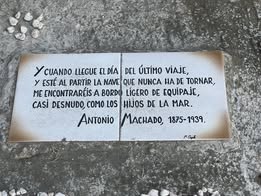
Y cuando llegue el día del último viaje,
Y esté al partir el nave que nunca ha de tornar,
Me encontraréis a bordo ligero de equipaje,
Casí desnudo, como los hijos de la mar.
Epitaph
"And when the day comes for the final voyage,
The ship of no return shall leave the quay,
You’ll find me gone aboard with not much baggage,
Near naked, as the sons of the sea."
Yo meditaba absorto, devanando
los hilos del hastío y la tristeza,
cuando llegó a mi oído,
por la ventana de mi estancia, abierta
a una caliente noche de verano,
el plañir de una copla soñolienta,
quebrada por los trémolos sombríos
de las músicas magas de mi tierra.
... Y era el Amor, como una roja llama...
?Nerviosa mano en la vibrante cuerda
ponía un largo suspirar de oro
que se trocaba en surtidor de estrellas?.
... Y era la Muerte, al hombro la cuchilla,
el paso largo, torva y esquelética.
?Tal cuando yo era niño la soñaba?.
Y en la guitarra, resonante y trémula,
la brusca mano, al golpear, fingía
el reposar de un ataúd en tierra.
Y era un plañido solitario el soplo
que el polvo barre y la ceniza avienta.
Deep Song
I was sunk in thought,unwinding
The threads of disgust and sorrow,
When something came to my ears
Through my room’s open window,
On that hot night of summer:
The moan of a drowsy song.
Dark tremolos, witching music
Of my southland: a hint of wrong.
…It was Love, like a red red flame…
Did a nervous hand put a sigh
Ample and gold on the live string,
To nourish the stars in the sky?
…It was Death, his scythe on his shoulder,
Skeletal, grim, broad pacing.
Did I dream it, before I grew older?
The guitar was tremulous, vibrant,
Strokes of a rough hand tracing
A shroud’s committal to clay.
The lonely lament was a night-wind,
Sweeps the dust, blows the ashes away.
Canto a Andalucía
Cádiz, salada claridad. Granada,
agua oculta que llora.
Romana y mora, Córdoba callada.
Málaga, cantaora.
Almería, dorada.
Plateado, Jaén. Huelva, la orilla
de las tres carabelas.
Y Sevilla.
Cualquiera canta un cantar
Hasta que el pueblo las canta,
las coplas, coplas no son;
y cuando las canta el pueblo,
ya nadie sabe el autor.
Tal es la gloria, Guillén,
de los que escriben cantares:
oír decir a la gente
que no los ha escrito nadie.
Procura tú que tus coplas
vayan al pueblo al parar,
aunque dejen de ser tuyas
para ser de los demás.
Que, al fundir el corazón,
en el alma popular,
lo que se pierde de nombre
se gana de eternidad.
Confetti
Aquella noche, Pierrot
se bebió un rayo de luna
y se emborrachó.
Y, no pudiendo contar
las estrellas a la bruna,
se puso a llorar.
Se puso a llorar Pierrot.
Y aún lloraba el sinfortuna
cuando amaneció.
…Y pudo contarlas: Una.
Three songs for Children
Song to Andalucía
Cádiz, salt brightness. Granada,
sobbing of hidden water.
Córdova silent, Roman and Moor.
Málaga sings folklore.
Gold Almería. Jaén of silver.
Huelva, the shore,
three caravels…
and Sevilla.
Some woman is singing a song
Until the people sing it,
the ballad, there is none;
and when the people sing it,
the author’s name is gone.
That’s how it is, Guillén,
the song writer’s renown:
to hear people saying
the author is unknown.
See to it that your ballads
go to the people and stay there,
belonging to you no longer
but to all those others.
Pouring out its heart
into the soul of the people,
what it loses in name
it gains in being eternal.
Confetti
Pierrot that night
Drank down a moonbeam:
He was tight.
Can’t count the stars
It’s dark, oh poor him
He sheds tears.
Pierrot sheds tears,
Sobs on and on
Till at dawn
He counts: One.
Muy cerca de mi ocaso, yo te bendigo, Vida,
porque nunca me diste ni esperanza fallida,
ni trabajos injustos, ni pena inmerecida;
porque veo al final de mi rudo camino
que yo fui el arquitecto de mi propio destino;
que si extraje la miel o la hiel de las cosas,
fue porque en ellas puse hiel o mieles sabrosas:
cuando planté rosales coseché siempre rosas.
Cierto, a mis lozanías va a seguir el invierno:
¡mas tú no me dijiste que mayo fuese eterno!
Hallé sin duda largas las noches de mis penas;
mas no me prometiste tan sólo noches buenas;
y en cambio tuve algunas santamente serenas…
Amé, fui amado, el sol acarició mi faz.
¡Vida, nada me debes! ¡Vida, estamos en paz!
Making the Life, Making the Self
As I come near my setting, I give you, Life, my blessing,
Because you never gave me disappointed expectation,
Nor labours of injustice nor unmerited vexation;
For being at the finish of my rocky road I see
That I myself was architect of all my destiny:
That if I wrested out of things the honey or the gall,
’Twas I who put the sourness or the sweetness in them all.
Each time I plant a rose-bush, rose-blooms galore I gather;
’Tis certain my resplendence must yield to wintry weather,
But no, you never said to me that May would last for ever!
For sure I found them lengthy, my nights of misery,
But nights of constant comfort you never promised me;
And some indeed were blessings of pure serenity…
I loved and I was loved: the mighty sun caressed my face.
O Life, you owe me nothing! O Life, we are at peace!
Muy cerca de mi ocaso, yo te bendigo, Vida,
porque nunca me diste ni esperanza fallida,
ni trabajos injustos, ni pena inmerecida;
porque veo al final de mi rudo camino
que yo fui el arquitecto de mi propio destino;
que si extraje la miel o la hiel de las cosas,
fue porque en ellas puse hiel o mieles sabrosas:
cuando planté rosales coseché siempre rosas.
Cierto, a mis lozanías va a seguir el invierno:
¡mas tú no me dijiste que mayo fuese eterno!
Hallé sin duda largas las noches de mis penas;
mas no me prometiste tan sólo noches buenas;
y en cambio tuve algunas santamente serenas…
Amé, fui amado, el sol acarició mi faz.
¡Vida, nada me debes! ¡Vida, estamos en paz!
In Peace
Very near my sunset
My blessings on you, Life,
Because you never told me
Of hopes that would deceive
Nor of unjust labours
Nor undeserving grief.
For I see at the finish
Of my uneven journey
That I was the designer
Deviser of my destiny;
I drew out gall or honey
As much as I inserted:
If rosebushes I planted,
Then roses were my harvest.
For sure my horn of plenty
Will soon give way to winter,
But then you never told me
That May would last for ever!
Certainly I encountered
Long nights, my nights of sorrow:
But then you never promised
My nights would all be good ones;
Some were a benediction…
I loved and I was loved,
The sun caressed my face.
Life, you owe me nothing!
Life, we are at peace!
Pastores y pastoras,
abierto está el edén.
¿No oís voces sonoras?
Jesús nació en Belén.
La luz del cielo baja,
el Cristo nació ya,
y en un nido de paja
cual pajarillo está.
El niño está friolento.
¡Oh noble buey,
arropa con tu aliento
al Niño Rey!
Los cantos y los vuelos
invaden la extensión,
y están de fiesta cielos
y tierra... y corazón.
Resuenan voces puras
que cantan en tropel:
Hosanna en las alturas
al Justo de Israel!
¡Pastores, en bandada
venid, venid,
a ver la anunciada
Flor de David!...
Christmas Night
Shepherds, shepherdesses,
Eden is unbarred.
Hear the sounding voices!
Born today Our Lord.
Born today is Christ:
radiant are the skies.
Straw is all the nest
where the birdling lies.
Noble ox, behold
baby shivering.
Warm breath in the cold,
robe the infant king!
Angel-wings and voices
fill the furthest part:
heaven’s host rejoices,
heaven, earth… and heart.
Hear the sounding chorus,
all the troop of them,
loud extol His glories,
born in Bethlehem!
Come, you band of shepherds,
flocking from the fold:
see the son of David
long ago foretold!
Por ti, por ti, clamaba cuando surgiste,
infernal arquetipo, del hondo Erebo,
con tus neutros encantos, tu faz de efebo,
tus senos pectorales, y a mí viniste.
Sombra y luz, yema y polen a un tiempo fuiste,
despertando en las almas el crimen nuevo,
ya con virilidades de dios mancebo,
ya con mustios halagos de mujer triste.
Yo te amé porque, a trueque de ingenuas gracias,
tenías las supremas aristocracias:
sangre azul, alma huraña, vientre infecundo;
porque sabías mucho y amabas poco,
y eras síntesis rara de un siglo loco
y floración malsana de un viejo mundo.
Androgyne
Infernal archetype! I cried
to you… From Hades’ lowest place,
your neuter charms, ephebic face,
light-muscled breasts, rose to my side.
You, bud and pollen, light and shade,
roused souls to novel infamy:
a callow god’s virility,
the stale endearments of a jade.
No grace, no goodness: none of that.
I loved the arch-aristocrat,
blue blood, wild spirit, barren womb:
you knew the more, you loved the less,
adding a Zeitgeist’s recklessness
to an old world’s unwholesome bloom.
Ve un zorzal a un pavo real
que se esponja y gallardea;
le mira la pata fea
y exclama:- “¡Horrible animal!”
sin ver la pluma oriental,
el pájaro papanatas.
Gentes que llaman sensatas
son otros tantos zorzales:
cuando encuentran pavos reales
sólo les miran las patas.
‘Yo soy Nicaraguense y la historia de como nace este poema cuentan, que fue en un mesón. Todo un pueblo se había reunido para dar la bienvenida a Ruben Darío ya adentro del mesón llega una señora de alta sociedad se acerca a uno de los presentes y le pregunta ?ya vino Ruben Darío? a lo cual el hombre le contesta, ¡si¡ el es Rubén Darío, la mujer muy desepcionada le dice: ¡huy, ese es Ruben Darío? lo cual logra escucharlo el y le responde creando esos versos.’
The Thrush and the Peacock
A thrush sees a peacock put
up its feathers, a beautiful feature,
but looks at its ugly foot,
and cries 'What a horrible creature!'
- the eastern plumage is not
observed by the bird, poor clot.
People too mean with words
are like thrushes, pitiful birds,
who do nothing if they meet
a peacock, but look at its feet.
‘I am Nicaraguan and here’s the story of this poem’s origin. A whole village had assembled in a tavern to welcome Ruben Darío. He was already there when a high society lady approached someone present and asked: Has Ruben Darío come yet? The man replied: Yes, that’s Ruben Darío. The woman, very disappointed, said: Pooh, is that Ruben Darío? Which he heard, and responded by composing these lines.’
Agranda la puerta, padre,
porque no puedo pasar;
la hiciste para los niños,
yo he crecido a mi pesar.
Si no me agrandas la puerta,
achícame, por piedad;
vuélveme a la edad bendita
en que vivir es soñar.
Gracias, padre, que ya siento
que se va mi pubertad;
vuelvo a los días rosados
en que era hijo no más.
Hijo de mis hijos ahora
y sin masculinidad
siento nacer en mi seno
maternal virginidad.
Epiphany
Make the door wider, my father:
through it I cannot pass.
You made a door for children:
I’ve grown bigger, alas.
If you don’t make it wider,
let me again be small:
give back the newness of living,
the age when dreaming is all.
Thank you, my father, I sense now
That my puberty is gone;
I return to the days that were rosy
When I was only a son.
Now I’m a son of my own sons.
Without any masculinity,
I sense the birth within me
Of a motherly virginity.