HUMORAGE TO PICASSO

Humorage à Picasso

Roger Vitrac (1899-1952)

Humorage à Picasso
Et vive le pinceau De l’ami Picasso! - Apollinaire Cet arbre fait comme un tombeau, Cet astre comme un numéro, Ce soleil comme un escargot, C’est Picagot. Ce journal ni joli, ni beau, Cette sciure de gâteau, Ce double sein comme un étau, C’est Picétau. Ces cheveux poussant dans un pot, Cet œil pareil aux culs d’oiseaux, Ce marétal porte-marcheau, C’est Picacheau. Ce mou, ce dur, ce matériau, Moulé, pompé comme la chaux, Colorié à coups de plumeau, C’est Picaplo. Ce dos, ce pal, ce paletot, Ce récit mis comme un fardeau Sur la tartine de Toto, C’est Picato. Ce sol tout nu, ce ciel sans os, Cette baigneuse comme un gigot, Et ce cheval comme un sabot, C’est Pisabot. Socrate au torse de fourneau, Divisant le diamant des eaux Pour l’épingler dans un tableau, C’est Pitableau. L’allumette épinglant le faux, La faulx imitant le râteau, Pour peindre un rire à l’Otéro, C’est Picaro. Enfin, Napoléon changeant de peau, La peau changeant de poils labiaux, Et les poils changeant de pinceau, C’est Picasso!
HUMORAGE TO PICASSO
Our pal Picasso, Long live his brush-oh! Pirate and corsair, Here’s to his horsehair! [Apollinaire] This star like a digit, This tree like a tomb, This sun like a mollusc, Picasso, that’s whom! This nondescript newsprint, Twin screw-clamp bazoom, This gateau-crumb sawdust, Picasso, that’s whom! This plant-pot with hair on, Eyes like a bird’s bum, Top brass-knocker’s knapsack, Picasso, fo fum! This soft stuff, this tough stuff, Touched up with a broom, Pump-grind it to lime-sludge, Picasso, that’s whom! This topcoat, this back-stick, This talk, spread like lipstick On small buttered biscuit – Picasstic! This boneless sky, bare leafless view, Beach-beauty like a lamb jigoo, This horseflesh like a wooden shoe – Picashoo! This Socrates, stove-torso, Splits diamond-ice from water To prick a picture-pableau, Picorso! This matchstick pricking a mistake, This scythe that imitates a rake, To paint a laugh on Frou-Frou – who? Picuckoo! Last verse Napoleon’s fresh husk-oh, Fresh husk on the nap-oh, Fresh nap on the brush-oh, Picasso!
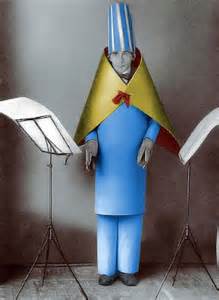
On the wall in Surrealist Art, Hayward Gallery, London, 2006.

Translation: Copyright © Timothy Adès
More poems by Roger Vitrac...

Two Poems From “Cabaret Voltaire”

Cabaret Voltaire zwei Gedichte

Hugo Ball (1886-1927)

Cabaret Voltaire zwei Gedichte
3 Der Exhibitionist stellt sich gespreizt am Vorhang auf, Und Pimpronella reizt ihn mit den roten Unterröcken. Koko der grüne Gott klatscht laut im Publikum. Da werden geil die ältesten Sündenböcke. Tsingtara! Da ist ein langes Blasinstrument. Daraus fährt eine Speichelfahne. Darauf steht: »Schlange«. Das packen alle ihre Damen in die Geigenkästen ein Und verziehen sich. Da wird ihnen bange. Am Eingang sitzt die ölige Camödine. Die schlägt sich die Goldstücke als Flitter in die Schenkel. Der sticht eine Bogenlampe die Augen aus. Und das brennende Dach fällt herunter auf ihren Enkel. ‘4’ Von dem gespitzten Ohr des Esels fängt die Fliegen Ein Clown, der eine andre Heimat hat. Durch kleine Röhrchen, die sich gründlich biegen, Hat er Verbindung mit Baronen in der Stadt. In hohen Luftgeleisen, wo sich enharmonisch Die Seile schneiden, drauf man flach entschwirrt, Versucht ein kleinkalibriges Kamel platonisch Zu klettern; was die Fröhlichkeit verwirrt. Der Exhibitionist, der je zuvor den Vorhang Bedient hat mit Geduld und Blick für das Douceur, Vergißt urplötzlich den Begebenheitenvorgang Und treibt gequollene Mädchenscharen vor sich her.
Two Poems From “Cabaret Voltaire”
3 The Impresario struts round the curtain, Bewitched by Pimpronelle’s red petticoats. Loud chatter in the stalls from green god Coco. Lust stirs in all the oldest Guilty-Goats. Tsingtara! blast from somthing long and brassy. Out comes a spittle-banner: ‘Snake’ – five letters. All pack their ladies in their fiddle-cases, Make themselves scarce, because they’ve got the jitters. Oily Miss Camodine sits at the entrance, Thighs tinselled with gold coins she got her hands on. Sadly, her eyes are poked out by an arc-lamp. The burning roof collapses on her grandson. ‘4’ Fleas from the donkey’s pointed ear are quarried, Bagged by a man from somewhere else, a clown. Little green funnels, folded up and carried, Give him a link with notables in town. On the high platforms where the enharmonic Ropes intersect, where the flat walk dives off, A small-bore camel hazards a platonic Montage; and people hesitate to laugh. The Impresario, who manned the curtain, Patient, alert for tips, aware of form, Forgets his good behaviour all of a sudden, Drives girls before him in a turgid swarm.
Published in A Dada Reader, Tate Publishing, 2006 (an earlier version) and in Poetry Salzburg Re="httpview, and in Agenda 2018.

Translation: Copyright © Timothy Adès
More poems by Hugo Ball...

Black on Wise – a Dada poem

weisst du schwarzt du

Hans Arp (1886-1966)

INTRODUCTIONHans (Jean) Arp, born Strasbourg 1886, died Basle 1966; poet in French and German, sculptor, painter and artist in wood, stone, metal, paper, string; dadaist-surrealist. ‘Arp was a man distinguished by simplicity, gentleness, integrity and wisdom . . . Humour was an essential part of his outlook on life, and his fantasy, even in his early Dada days, was never violent or deranged’ (Sir Herbert Read, Arp, London, 1968, p. 60). Weisst du schwarzt du appeared in Zurich in 1930 with illustrations by Ernst, but had been written and published piecemeal in 1922-26; parts reappeared much later in Arp's own French translation. This is probably the first English version of the full 1930 text; no work of his is more amenable to English wordplay.‘Between 1914 and 1930 I read medieval chronicles, popular tales and folk-songs; and, with special delight, the Knabenwunderhorn, this book which sounds “as never harp or woman’s song or bird overheard.” I loved street ballads and drinking songs. Children's poems and drawings had a special influence on me...’ (Wegweiser, 1951).Arp at this time also carved and depicted natural objects, clouds, fruits, animals, often strangely merged.The translator would like to acknowledge the assistance of Cornelie Usborne. Tim Ades has written articles, poems and translations of poetry and has worked as an editor Published in Comparative Criticism no: 6, 1984, Edited by E.S Schaffer, Cambridge University Press
weisst du schwarzt du
1 sie gehen ein quadrat einen kreis einen punkt und drehen sich auf dem punkt pünktlich halb um und wieder halb um und gehen weiter und wollen nicht ausratten auf der rattenmatte auf der zwölftesten platte und kürzen das kurze und verlängern das lange und verdünnen das dünne und verdicken das dicke und bleiben sich vis-a-vis und ziehen sich mit schuhlöffeln eisblumen an sie mauern wolken lebendig ein sie rollen wasserballen auf und fegen sie sie picken die schindeln von den linien und gackern dazu gack gack gack daß es allen gewellen ist und ohne grund unter dem unter spricht wie wir nach der uhr   2 ist dies diesseits ist jenes jenseits was hier ist scheucht sich auf wenn es sich setzen will was dort ist staffelt sich auf zu dem großen rand zu der beiderseitig befiederten seele ist dies diesseits ist jenes jenseits das vorderteil geht vorne hinaus das hinterteil geht hinten hinaus und die mitte bleibt stehen doch bevor die mitte sich vorstellt leert sich das wasser und füllt sich die flasche die hand hält das maul zu denn was gesprochen ist bekommt blut und sagt du aus den hemden hängen die erzschenkel und berühren die armeen den fruchtbaren jahren stehen die haare zu berg aber das wasser bleibt leer 3 eins ums andere unten geht das fremde fleisch mit trockenem auge und atmet und hat in jeder falte einen bauch langsam kann es seinen namen sagen wort um wort zeile um zeile weil es ein ebenes ist und hinter sich herrollt und zu sich paßt und sich versteht und sich immer kennt bis auf ein falsches brett dreimal klopft es gegen seinen finger herein herein herein dann steht der atemumriß mit den quecksilberlippen auf seiner zunge die unter ihm wegrollt mit viereckigen rädern die sich drehen wenn die speichen stillstehen und stillstehen wenn die speichen sich drehen jahr um jahr sind jahre ohne jahre tag um tag sind tage ohne tage so gehen auch die schaftstiefel artikuliert durch den lebendigen fleischschlauch schritt um schritt ungehemmt mit ihren jahresringen in gutsitzenden enganliegenden käfigen jahr um jahr sind jahre ohne jahre 4 die zwittrigen leiber sind oben viereckig in der mitte dünn an der seite flach innen hohl außen glatt haben ein drehbares bein wie ein klavierstuhl und ein genital aus stukkatur sie unterscheiden gut ihren vater von ihrer mutter ersterer liegt geringelt in einer klangfigur letztere ist weiblich die drittrigen leiber sind oben groß und rissig wie ein erdteil unten klein und fleischig wie ein überzwerg sie tragen rauchende schwielenhemden sie blasen auf ihrer eselsposaune wie         waldhanswurstkadetten ia ia ia sie blasen wie ein vokativ geblankverster gondelmehlsack nach den spielregeln geregelt für alle fälle einmal für todesfälle zweimal vom modenrot bis zum abendbrot 5 nach dem ersten glockenschlag der zweiten glocke sperrt die saat zahllose hungrige mäulchen weit auf kündigt die lieder und stellt die sprache dafür an aber mit einem leib und einem leib fällt das licht von sich ab und heizt die strahlen einen winter lang die globetracht klappert mit ihrem künstlichen gebill die sterne springen von ihren stielen nach dem dritten schuß der vierten kanone schließen sich die lippen und in rauchtalaren und geschminkten wellen kommen die wieder die sich nicht wegschickenlassen und rufen viktoria sie spannen sich zwischen haaren und federn eine haut und mästen sich an armen und beinen einen leib als wäre alles fleisch uber den großen reifen gespannt und grüßen guten abend geschweige denn gute nacht mit einem quaderledrig geblähten blätterfundament um den kugelrund gegockelten tonsurenmast und springen vorwärts mit den fassaden nach vorne wie das vorderteil mit dem kinderteil über die wolkenhürde 6 er nimmt zwei vögel ab er nimmt zwei vögel zu er paust grimassen auf die luft und unter das wasser er lebt tête-à-tête pied-a-pied handgemein fußvornehm und leib an leib mit seinem leib sieht er drei eier so ruft er ei ei und zählt doch richtig ein bei bei zwei zwei bei bei drei er hebt an der urgroßvaterstadt das rechte bein hoch er hebt an der urgroßmutterstadt das linke bein hoch er nimmt zwei vögel ab er nimmt zwei vögel zu er heißt mit vornamen zwölf und mit familiennamen zwölf das macht in summa vierundzwanzig er hat eine vorderseite und eine hinterseite das macht in summa sechsundzwanzig er hat einen rechten männerarm und einen linken frauenarm das macht in summa achtundzwanzig er huldigt der mode der doppelgängerei mit fahnen aus haaren und segeln aus federn er ist vorne so lang wie hinten er nimmt zwei vögel ab er nimmt zwei vögel zu 7 gott ist den zylinderhüten angeboren aus den ohren der sterne fallen atheistische rosen was fällt denn sonst noch aus der kruste der jahre ich trage an meinem goldast einen ehering ein ehering besteht aus einem kranz aus luft und einem punkt aus licht unter den öffentlichen körpern trage nur ich einen ehering meine untere kopflänge schläft ein mein feuer ist gekocht auf dem höchsten zweige des turmes leben die mundlosen kisten die ohrenlosen fässer die augenlosen säcke die fünfsinnigen tüten nein nein sie fliegen nimmermehr davon der weg bleibt ihnen unter den füßen stehen sie werden von vorne gezogen von hinten gestoßen von oben gehalten von unten getragen wie die gebrüder es war einmal und vor vielen vielen jahren von meiner möblierten decke fällt ein felsen petri an einer gut möblierten decke hangen flügge sterne karbolaquarien und felsen petri die augen meiner schlummerrolle sind for immer geschlossen meine schraubstöcke sind voller eier 8 und stößelt abermals und nochmals und für und für und einmal zweimal dreimal bis tausend und fängt von vorne wieder an und stößelt das große einmaleins und das kleine         einmaleins und stößelt und stößelt und stößelt seite 222 seite 223 seite 224 und so fort bis seite 229 überschlägt seite 300 und fährt mit seite 301fort bis seite 400 und stößelt das einmal vorwärts zweimal rückwärts dreimal aufwärts und viermal abwärts und stößelt die zwölf monate und die vier jahreszeiten und die sieben wochentage und die sieben töne der tonleiter und die sechsfüßigen jamben und die geraden hausnummern und stößelt und stößelt das ganze zusammen und es stimmt und gibt eins 9 das mundgerät nimmt nicht notiz von dem verplapp vermummte muhmenwörter stehen ihm spalier es bändigt ein es bändigt zwölf es händigt zwei es händigt vier mit den großen daumen und den kleinen zehen mit herabgelassenen rolladen wie der brei um die heißen katzen streicht es seine linie so so streicht es seinen strich la la es wendigt aus es wendigt in mit einem rechten auge links mit einem linken auge rechts und steht der knochenkokotte nur in den pausen zur verfügung so gibt ein wort das andere schiebt das riegelfleisch zurück schnallt den bimssteinorden ab grüßt mit seinem frohnhut das stelldichein und trägt den tod im ranzen fort es bändigt ein es bändigt zwölf es händigt zwei es händigt vier mit sordiniertem stimmband und stündlich einer stunde ellenbein und schienen­ bogen an der schnur ist die munduhr abgelaufen so rollt der lebende ballast heraus kommandiert rührt euch und löscht den lichterast 10 die sphinxe strecken vorsichtig ihre nasen aus der rinde denn der herr faden bringt das seil und der herr seil bringt den faden um den sack voller bannbullenfalter zuzubinden immer schneller wachsen die knochen in den steinen im fundament eitern die küsse die augen sind nicht mehr an den schuhen befestigt die vasen seufzen wie diamanten näht man einen gackernden strauß an diesen frohen     festtag so wird ein kopf daraus der sich sofort im spiegel besieht und sich fragt bin ichs oder bin ichs nicht das gleiche fragen sich auch die gefalteten handschuhe wenn ihre komfortablen zungen folgendes gebet sprechen gehe nach oben und stoße nach unten gehe nach unten und stoße nach oben gehe nach vorne und stoße nach hlnten gehe nach hinten und stoße nach vorne gehe nach rechts und stoße nach links gehe nach links und stoße nach rechts darum nimmt man am besten die hüte von den masten und übrigen kreuze die innerlichen schlipse von den hälsen und die zölibateier von den triumphbögen und legt sie wieder auf den schöpfungstisch zurück setzt die lorbeerbedeckten viertelstündchen auf     ihre eintagsstühle ordnet die eintagsstühle und den schöpfungstisch streng in der form einer interimsbrezel an quittiert dann schleunigst seine schuhe und überläßt das übrige dem finalaal mit dem gratis sich anschließenden flurschaden
Black on Wise – a Dada poem
1 they go a square a circle a point and turn on the point punctually half round and half round again and go on further and will not rat out on the ratmat on the twelfthest flat and make the short shorter and make the long longer and make the thin thinner and make the thick thicker and stay opposite each other and put on iceflowers with shoehorns they wall up clouds alive they roll up waterfalls and sweep them they peck the little tiles from the lines and cackle at it cack cack that it's wavy for all and speaks without a ground under the under like us after the clock 2 is there thereafter is here hereafter what's here scares itself when it wants to sit down what's there stacks itself up step by step to the big edge to the soul feathered on both sides is there thereafter is here hereafter the forepart goes out in front the hinder part goes out behind and the middle stays still but before the middle presents itself the water empties itself and the bottle fills itself the hand keeps its mouth shut for what is spoken comes good blood and is intimate the archthighs hang out of the shirts and touch the armies the fertile years' hair stands on end but the water stays empty 3 one after the other the alien flesh goes below dry-eyed and breathes and has a belly in every fold it can say its name slowly word by word line by line because it is flat and rolls along behind itself and fits itself and understands itself and knows itself always except for one false board three times it knocks against its finger come in come in come in then the outline of a breath with the mercury lips stands on its tongue which rolls away under it with square wheels that turn when the spokes stand still and stand still when the spokes turn year after year years have no years day after day days have no days so too the jackboots go articulated through the living tube of flesh step by step not encumbered by their annual rings in well-tailored tightly-fitting cages year after year years have no years 4 the ambisexual bodies are square on top thin in the middle flat at the side hollow inside smooth outside have a revolving leg like a piano-stool and a genital of stucco they easily tell their father from their mother the former is curled in an acoustic figure the latter is female the trisexual bodies are big on top and fissured like a continent small lower down and fleshy like a superdwarf they wear smoking shirts of callouses they blow their jackass trumpet like goofy cadets in the wood heehaw heehaw heehaw they blow like a vocatively blankversed gondola-fattypuff ruled by the rules of the game once in any eventuality twice if anything lethal were to happen from chic red sky to shepherd's pie 5 after the first chime of the second bell the seed opens wide to no end of hungry little gobs announces the songs and provides the words for them but with a body and a body the light falls away from itself and warms the rays all winter long the globe costume chatters with its artificial teeth the stars jump from their stalks after the third shot of the fourth gun the lips close and in robes of smoke and tarted-up waves back they come refusing to be sent away and cry victory they put out a skin between hair and feathers and nourish a body on arms and legs as though every thing were flesh stretched over the big hoops and call out good evening let alone good night with a foundation of leaves puffed by quarried leather round the roundbellied weathercocked tonsure pole and jump forwards with their façades to the front with the hinder part over the cloud hurdle     6 he goes down two birds he goes up two birds he traces grins on the air and under the water he lives tête-à-tête pied-à-pied hand under hand foot above board and body to body with his body seeing three eggs he eggs them on hay hay yet he counts right one yoo you two two yoo we three at the great-grandfather city he lifts his left leg at the great-grandmother city he lifts his right leg he goes down two birds he goes up two birds his forename is twelve and his surname is twelve making twenty-four altogether he has a frontside and a backside making twenty-six altogether he has a right men’s arm and a left women’s arm making twenty-eight altogether he follows the fashion of ambipersonality with banners of hair and sails of feathers he is as long in front as behind he goes down two birds he goes up two birds 7 god is congenital to top hats atheist roses fall from the stars’ ears what else falls from the crust of the years on my gold branch i wear a wedding ring a wedding ring consists of a wreath of air and a point of light of all the public bodies i alone wear a wedding-ring my lower head-length is going to sleep my fire is boiled on the highest twig of the tower live the mouthless boxes the earless barrels the eyeless sacks the five sensed bags no no they fly away nevermore the path stays still under their feet they are pulled from in front pushed from behind held from above borne from below like the brothers once-upon-a-time and many-many-years-ago from my furnished ceiling a petrine rock is falling on a well-furnished ceiling hang fledgling stars carbolaquariums     and petrine rocks my sleeping-bag has shut its eyes forever my screw clamps are full of eggs     8 and pestles again and again and yet again and for and for and once twice three times up to a thousand and starts again from the beginning and pestles the big times-table and the little times-table and pestles and pestles and pestles page 222 page 223 page 224 and so on up to page 229 misses out page 300 and goes on from page 301 to page 400 and pestles the once forwards twice backwards three times     upwards and four times downwards and pestles the twelve months and the four seasons and the seven days of the week and the seven notes of the scale and the six-footed iambs and the even house-numbers and pestles and pestles the whole lot together and it's right and makes one 9 the mouth- trumpet takes no notice of the tell-tale-tit muffled auntjemima words line its path it bridles one it bridles twelve it handles two it handles four with the big thumbs and the little toes with lowered blinds like soup round the hot cats it draws its line so so it draws its bow la la it sidles out it sidles in with a right eye left with a left eye right and only in the intervals offers the bony cocotte its services so one word gives the next pushes the boltflesh back unclips the pumicestone medal raise its thraldom hat to the rendezvous and carries death out in its bag it bridles one it bridles twelve it handles two it handles four with muted vocal cord and hourly of an hour elbone and shinbow on the string if the mouthclock ran down the living ballast rolls out gives the command stand easy and puts out the branch of lights 10 the sphinxes carefully stick their noses out of the bark for mr thread is bringing the rope and mr rope is bringing the thread to tie up the sack full of papal bull butterflies faster and faster grow the bones in the stones the kisses suppurate in the foundations the eyes are no longer fastened to the shoes the vases sigh like diamonds if you stitch a cackling bunch of ostrich-feathers on to this very special day it turns into a head which at once looks at itself in the mirror says is it i or is it not i the same question occurs to the folded gloves when their well-appointed tongues utter the following prayer go upward and push downward go downward and push upward go forward and push backward go backward and push forward go right and push left go left and push right so the best thing for you to do is to take the hats from the poles and all the other crosses the inner ties from the necks and the celibate eggs from the triumphal arches and put them back on the creation table put the laurel-covered little quarter-hours on to their one-day chairs arrange the one-day chairs and the creation table strictly in the form of a provisional pretzel then quit your shoes at top speed and leave the rest to the final aardvark with damage to crops thrown in free
Published in Comparative Criticism no: 6, Cambridge University Press.

Translation: Copyright © Timothy Adès

More poems by Hans Arp...

Art

Categories
French

Art

THÉOPHILE GAUTIER (1811-72)

Oui, l’oeuvre sort plus belle D’une forme au travail Rebelle, Vers, marbre, onyx, émail. Point de contraintes fausses! Mais que pour marcher droit Tu chausses, Muse, un cothurne étroit. Fi du rhythme commode, Comme un soulier trop grand, Du mode Que tout pied quitte et prend! Statuaire, repousse L’argile que pétrit Le pouce Quand flotte ailleurs l’esprit. Lutte avec le carrare, Avec le paros dur Et rare, Gardiens du contour pur; Emprunte à Syracuse Son bronze où fermement S’accuse Le trait fier et charmant; D’une main délicate Poursuis dans un filon D’agate Le profil d’Apollon. Peintre, fuis l’aquarelle, Et fixe la couleur Trop frêle Au four de l’émailleur. Fais les sirènes bleues, Tordant de cent façons Leurs queues, Les monstres des blasons; Dans son nimbe trilobe La Vierge et son Jésus, Le globe Avec la croix dessus. Tout passe. — L’art robuste Seul a l’éternité, Le buste Survit à la cité, Et la médaille austère Que trouve un laboureur Sous terre Révèle un empereur. Les dieux eux–mêmes meurent, Mais les vers souverains Demeurent Plus forts que les airains. Sculpte, lime, cisèle; Que ton rêve flottant Se scelle Dans le bloc résistant!
Art
Yes, a work comes out better that’s hewn and won from matter perverse: enamel, onyx, marble, verse. For false rules we’ve no use! But to go straight as an arrow, Muse, your shoe needs to be narrow. Down with commodious rhythm that’s like an outsize boot, whose fathom fits and fails every foot! Modeller, shun, for it slips at your finger–tips, the clay, should thoughts go astray; grapple with travertine, or rarer parian; guard pure line of contour with hard carrara; borrow from Syracuse her bronze, standing firm to accuse proper pride and charm; make dextrously, chase in a perfect nugget of agate Phoebus’s beaked face. Painter, eschew the gouache: fix the frail timbres at fire–flash in the enameller’s embers. Make mermaids and dolphins, twist in fivescore fashions their tailfins, blue monsters of blazons; haloed in triple lobe, limn Mary and her Son; the globe, and His Cross thereon. All passes. — Robust art lives for ever; the bust is the city’s survivor. The dull medal, found by humble labourer beneath ground, reveals an emperor. Even gods perish, yet peerless stanzas flourish, stronger than bronzes. Sculpt, chisel, rasp: let the precisian block grasp your dancing vision!

Translation: Copyright © Timothy Adès

More poems by THÉOPHILE GAUTIER...

Preface

Categories
French

Preface

THÉOPHILE GAUTIER (1811-72)

During the imperial strife Goethe, to grim cannon’s noise, wrote his Westerly Divan, art’s oasis, breath of life: chose the Bulbul, shunned the Swan, wore the scent of sandalwood, and in oriental voice penned the love-song of Hudhud. As Goethe, propped on his divan at Weimar, totally withdrawn, plucked petals from Hafiz’s rose, so I, despite the hurricane that lashed the panes that I drew close, made my Enamels and Cameos.
Preface
Pendant les guerres de l’empire, Goethe, au bruit du canon brutal, Fit le Divan occidental, Fraîche oasis où l’art respire. Pour Nisami quittant Shakspeare, Il se parfuma de santal, Et sur un mètre oriental Nota le chant qu’Hudhud soupire. Comme Goethe sur son divan A Weimar s’isolait des choses Et d’Hafiz effeuillait les roses, Sans prendre garde à l’ouragan Qui fouettait mes vitres fermées, Moi, j’ai fait Émaux et Camées.

Translation: Copyright © Timothy Adès

More poems by THÉOPHILE GAUTIER...

From Ramsgate to Antwerp

De Ramsgate à Anvers

Gérard de Nerval (1808-55)

De Ramsgate à Anvers
À cette côte anglaise J’ai donc fait mes adieux Et sa blanche falaise S’efface au bord des cieux! Que la mer me sourie! Plaise aux dieux que je sois Bientôt dans ta patrie, Ô grand maître anversois! Rubens! à toi je songe, Seul peut–être et pensif Sur cette mer où plonge Notre fumeux esquif. Histoire et poésie, Tout me vient à travers Me mémoire saisie Des merveilles d’Anvers. Cette mer qui sommeille Est belle comme aux jours, Où, riante et vermeille, Tu la peuplais d’Amours. Ainsi ton seul génie, Froid aux réalités, De la mer d’Ionie Lui prêtait les clartés, Lorsque la nef dorée Amenait autrefois Cete reine adorée Qui s’unit aux Valois, Fleur de la Renaissance, Honneur de ses palais, — Qu’attendait hors la France Le coupe–tête anglais! Mais alors sa fortune Bravait tous les complots, Et la cour de Neptune La suivait sur les flots. Tes grasses Néréides Et tes Tritons pansus S’accoudaient tout humides Sur les dauphins bossus. L’Océan qui moutonne Roulait dans ses flots verts La gigantesque tonne Du Silène d’Anvers, Pour ta Flandre honorée Son nourrisson divin À sa boisson ambrée Donna l’ardeur du vin! — Des cieux tu fis descendre Vers ce peuple enivré, Comme aux fêtes de Flandre, L’Olympe en char doré, Joie, amour et délire, Hélas! trop expiés! Les rois sur la navire Et les dieux à leurs pieds! — Adieu, splendeur finie D’un siècle solennel! Mais toi seul, ô génie! Tu restes éternel.
From Ramsgate to Antwerp
To the far English coast I’ve said my goodbyes. Its white cliffs are lost at the brink of the skies. Smile, waves! and gods, grant we’re p– arked soon on the strand, at anchor at Antwerp, in Rubens’s land! This lugger is pitching, and rolling, and stinking. I’m skulking, and retching: yet of you, sir, I’m thinking! By the past I’m inspired, by verse, and your canvas; my memory’s fired by the marvels of Anvers. They laughed and they shone, those somnolent waves, that in days dead and gone you peopled with Loves. A genius alone, you disdained what was true, put the seas of Ionia, so bright and so blue. In a gilded careen she came alongside, the darling Scots queen, for the Dauphin, a bride. A flower of learning, a court of renown: then England, returning an axe for a crown. At first her good fortune survived every snare: by courtiers of Neptune the glass was set fair. Your Tritons paunch–tumid, your sea-nymphs well–stacked, were lounging all humid on dolphins round–backed. The sea–god’s retainers let the green frothing sea roll to the Scheldt, for Silenus, a very big barrel. He honoured your Anvers with liquors divine, to her brewmaster’s ambers gave courage of wine! To the Flemish Kermesse you brought down Olympus in a golden calèche on a heavenly nimbus. Joy, love, and the revel, more bitter than sweet: twin crowns on the vessel, the gods at their feet! Farewell to past splendours And pageant of years. Great master of Flanders, Your genius endures!
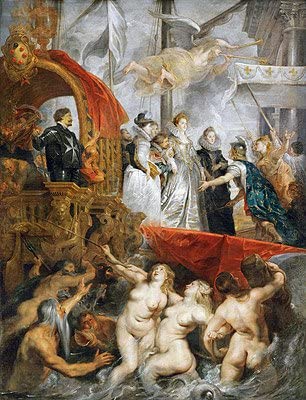
[caption id="attachment_2743" align="alignleft" width="306"]Maria de' Medici arriving at Marseille Nerval imagines a Rubens picture like this actual one of Maria de' Medici arriving at Marseille in 1600 (in Rubens's lifetime) to be Queen of France.[/caption]
Translation: Copyright © Timothy Adès

More poems by Gérard de Nerval...

Michael Angelo

Michel-Ange

Auguste Barbier (1805-82)

Michel-Ange
How sad thy face, how haggard is thy brow, Great master, Michael Angelo, of stone! To whom, like Dante, laughter was unknown, Nor ever on those cheeks did teardrops flow. Alas! A Muse’s-milk too rich hadst thou: Art took thy whole life, was thy love alone; For sixty years, three callings were thine own, Nor did thy heart dear heart’s ease ever know. Poor Buonarrotti! Thy one happiness, To stamp the marble with sublime impress, And, strong as God, to strike such awe as He; And so thou didst thy final hour attain, Weary old lion of the snowy mane, Long since replete with glory and ennui.
Michael Angelo
Que ton visage est triste et ton front amaigri, Sublime Michel-Ange, ô vieux tailleur de pierre! Nulle larme jamais n'a mouillée ta paupière; Comme Dante, on dirait que tu n'as jamais ri. Hélas! d'un lait trop fort la Muse t'a nourri, L'art fut ton seul amour et prit ta vie entière; Soixante ans tu courus une triple carrière Sans reposer ton coeur sur un coeur attendri. Pauvre Buonarotti! ton seul bonheur au monde Fut d'imprimer au marbre une grandeur profonde, Et, puissant comme Dieu, d'effrayer comme Lui: Aussi, quand tu parvins à ta saison dernière, Vieux lion fatigué, sous ta blanche crinière, Tu mourus longuement plein de gloire et d'ennui.

Translation: Copyright © Timothy Adès

More poems by Auguste Barbier...

Four Forks in a Square

Quatre fourches en carré

Nicolas Denisot – ‘Conte d’Alsinois’ (1515-59)

Quatre fourches en carré
Quatre fourches en carré, L'une sur l'autres penchantes, Sous un plancher bigarré, De tous côtés chancelantes, Étayent les quatre piliers De ce si tant beau repaire, Où les anges à milliers Ont vu la Vierge être mère. Tout le plancher de roseaux Et de paille ramassée, De torchis et de tuileaux, D'herbe sèche entrelacée, Était tout entièrement Lambrissé en telle sorte, Qu'on eût dit facilement Le tout n'être qu'une porte. Le froid, l'humide et le chaud, L'éclair, l'horreur, le tonnerre, Bref, ce qui tombe d'en haut Sur les sillons de la terre, Pouvaient tomber en ce lieu, En ce lieu sans couverture Qui a vu l'enfant de Dieu Naître d'une créature.
Four Forks in a Square
...Four forks in a square leaned on one another, propping up a patchwork layer, tottering together: these were pillars four of the fine abode where ten thousand angels saw Virgin motherhood. All of straw the strewing and of gathered rushes, smear of daub and broken tiling, weave of withered grasses: so it was devised, you would say for sure all that handiwork comprised but an open door… Thunder flashing bright, fog and heat and cold, all that falls from airy height on the furrowed field, so much could intrude on this roofless room, that beheld the child of God born of mortal womb.
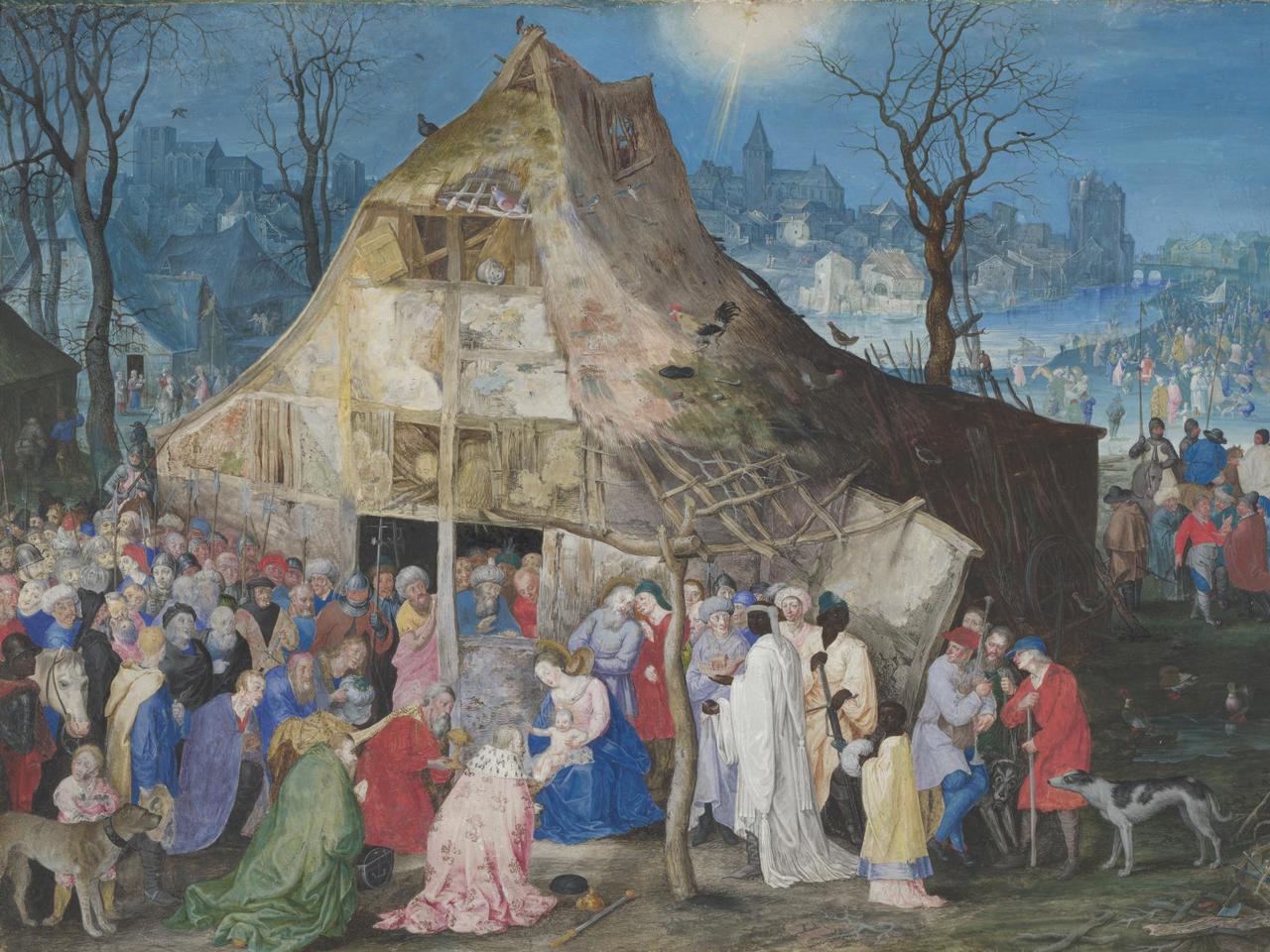
Painting by Jan Brueghel the Elder, National Gallery, London

Translation: Copyright © Timothy Adès

More poems by Nicolas Denisot – ‘Conte d’Alsinois’...