Mother of Arts
France, mère des arts
Joachim du Bellay (1522-60)
France, mère des arts
France, mère des arts, des armes et des lois,
Tu m'as nourri longtemps du lait de ta mamelle :
Ores, comme un agneau qui sa nourrice appelle,
Je remplis de ton nom les antres et les bois.
Si tu m'as pour enfant avoué quelquefois,
Que ne me réponds-tu maintenant, ô cruelle ?
France, France, réponds à ma triste querelle.
Mais nul, sinon Écho, ne répond à ma voix.
Entre les loups cruels j'erre parmi la plaine,
Je sens venir l'hiver, de qui la froide haleine
D'une tremblante horreur fait hérisser ma peau.
Las, tes autres agneaux n'ont faute de pâture,
Ils ne craignent le loup, le vent ni la froidure :
Si ne suis-je pourtant le pire du troupeau.
Mother of Arts
Mother of arts and arms and laws,
You’ve suckled me so long, my France.
Now like a lamb who calls his nurse
I cry your name through caves and glens.
Have you not sometimes called me Child?
Then why no answer, cruel France?
My plaint is sad, my wail is wild,
Yet only Echo gives response.
Lost among wolves, I crave the fold:
By winter’s breath I soon am chilled,
Quake in my skin with fear and shock.
Your other lambs are fed and filled,
They fear no wolf, nor wind, nor cold:
Am I the meanest of the flock?
Translation: Copyright © Timothy Adès
More poems by Joachim du Bellay...
Sonnets of Virtuous Love - 10
Sonnets de l'honnête amour -10
Joachim du Bellay (1522-60)
Sonnets de l'honnête amour -10
J'ai entassé moi-même tout le bois
Pour allumer cette flamme immortelle,
Par qui mon âme avecques plus haute aile
Se guinde au ciel, d'un égal contrepoids.
Jà mon esprit, jà mon coeur, jà ma voix,
Jà mon amour conçoit forme nouvelle
D'une beauté plus parfaitement belle
Que le fin or épuré par sept fois.
Rien de mortel ma langue plus ne sonne:
Jà peu à peu moi-même j'abandonne
Par cette ardeur, qui me fait sembler tel
Que se montrait l'indompté fils d'Alcmène,
Qui, dédaignant notre figure humaine,
Brûla son corps, pour se rendre immortel.
Sonnets of Virtuous Love - 10
Myself I've heaped the wood up high
to kindle this immortal flame.
My soul on soaring wing shall fly
to heaven, for the weight's the same.
My heart, my voice, my love, my mind,
shall greater comeliness acquire
than gold in seven shifts refined.
I slowly yield me to the fire,
and cease from mortal colloquy.
Like the unconquered god am I,
Alcmena's Hercules, who spurned
our human shape, whose body burned,
who gained his immortality.
Translation: Copyright © Timothy Adès
More poems by Joachim du Bellay...
Four Forks in a Square
Quatre fourches en carré
Nicolas Denisot – ‘Conte d’Alsinois’ (1515-59)
Quatre fourches en carré
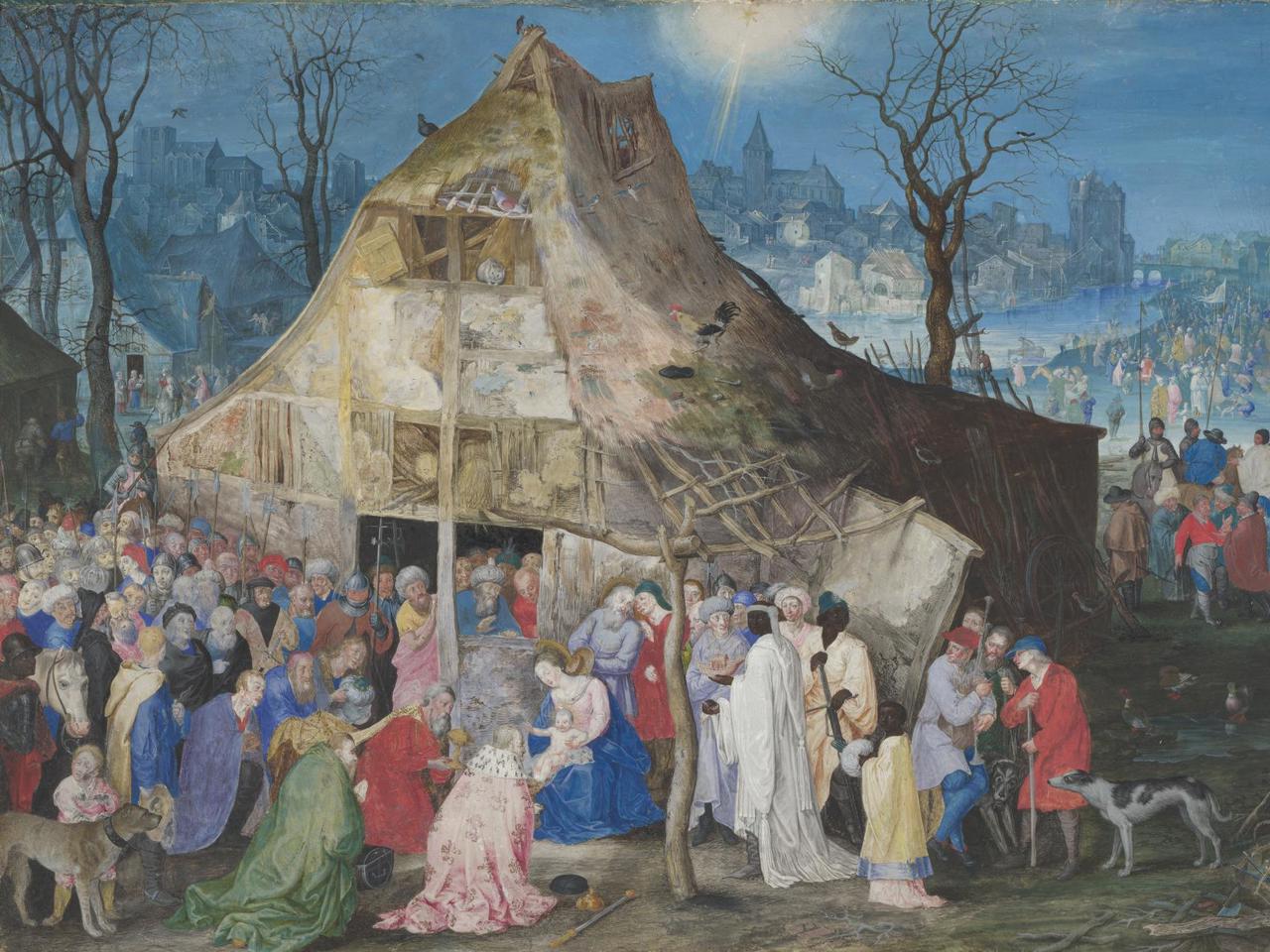
Quatre fourches en carré,
L'une sur l'autres penchantes,
Sous un plancher bigarré,
De tous côtés chancelantes,
Étayent les quatre piliers
De ce si tant beau repaire,
Où les anges à milliers
Ont vu la Vierge être mère.
Tout le plancher de roseaux
Et de paille ramassée,
De torchis et de tuileaux,
D'herbe sèche entrelacée,
Était tout entièrement
Lambrissé en telle sorte,
Qu'on eût dit facilement
Le tout n'être qu'une porte.
Le froid, l'humide et le chaud,
L'éclair, l'horreur, le tonnerre,
Bref, ce qui tombe d'en haut
Sur les sillons de la terre,
Pouvaient tomber en ce lieu,
En ce lieu sans couverture
Qui a vu l'enfant de Dieu
Naître d'une créature.
Four Forks in a Square
...Four forks in a square
leaned on one another,
propping up a patchwork layer,
tottering together:
these were pillars four
of the fine abode
where ten thousand angels saw
Virgin motherhood.
All of straw the strewing
and of gathered rushes,
smear of daub and broken tiling,
weave of withered grasses:
so it was devised,
you would say for sure
all that handiwork comprised
but an open door…
Thunder flashing bright,
fog and heat and cold,
all that falls from airy height
on the furrowed field,
so much could intrude
on this roofless room,
that beheld the child of God
born of mortal womb.
Translation: Copyright © Timothy Adès
More poems by Nicolas Denisot – ‘Conte d’Alsinois’...