Binsey Poplars

Binsey Poplars

Gerard Manley Hopkins

The poplars were felled in 1879. My Latin..
Binsey Poplars
My aspens dear, whose airy cages quelled, Quelled or quenched in leaves the leaping sun, All felled, felled, are all felled; Of a fresh and following folded rank Not spared, not one That dandled a sandalled Shadow that swam or sank On meadow & river & wind-wandering weed-winding bank. O if we but knew what we do When we delve or hew — Hack and rack the growing green! Since country is so tender To touch, her being só slender, That, like this sleek and seeing ball But a prick will make no eye at all, Where we, even where we mean To mend her we end her, When we hew or delve: After-comers cannot guess the beauty been. Ten or twelve, only ten or twelve Strokes of havoc unselve The sweet especial scene, Rural scene, a rural scene, Sweet especial rural scene. [Campaigning against a housing estate that would have scarred the view of Highgate from Hampstead Heath, I wrote: 'Witan, the ancient council. Hurst, a wooded hill. Not since the Binsey Poplars, those Hopkins-harrowing topplers, Fell or were felled by the fiend of eld that wishes old England ill, And the trains stopped stopping at Adlestrop, and at Grantchester time stood still, Has anything worse been heard in verse, including, if you will, The nefarious, unhilarious, Dissolution of Halnaker Mill.' ...]
Binsey Poplars
o quantum amatae vos mihi populi! Titana textis frondibus obrui ~~vidi refrenarique in auris; ~~~~praecipites cecidistis omnes, haud una sospes caede trucissima. intactus ordo duplicis agminis ~~occisus, umbrosis puellas ~~~~vel pueros recreare alutis gnarus, per agros, flumina, flamina, ventos vagantes, litora, harundines ~~per prata procurvas, per undas ~~~~nantibus his, aliis caducis. o stirps molesti nescia criminis, prompta ad fodendum, scindere promptior! ~~~torquemus increscens, virescens ~~~~ dilaniamus, in omne damnum. rus tenue tactu, rus tenerum ambitu! levis videndi fixus acu globus: ~~ instanter, heu! non est ocellus. ~~~~sic etiam reparare nisi pala et securi, deruimus modo saltus amoenos : nesciet advena ~~quantum venustatis fuisset: ~~~~undecimus decimusve tantum stragi sat ictus: conficit eripit prospectum agrestem, gaudia rustica ~~dejecta: prospectum placentem ~~~~destruit egregium, placentem.
Classical Verse Challenge for April 2024.

Translation: Copyright © Timothy Adès
More poems by Gerard Manley Hopkins...

Autumn

Automne

René-Guy Cadou (1920-51)

Automne
Odeur des pluies de mon enfance Derniers soleils de la saison! A sept ans comme il faisait bon, Après d’ennuyeuses vacances, Se retrouver dans sa maison! La vieille classe de mon père, Pleine de guêpes écrasées, Sentait l’encre, le bois, la craie Et ces merveilleuses poussières Amassées par tout un été. O temps charmant des brumes douces, Des gibiers, des longs vols d’oiseaux, Le vent souffle sous le préau, Mais je tiens entre paume et pouce Une rouge pomme à couteau.
Autumn
My childhood: fragrances of rain, The season’s final sunny days, When I was seven years of age After the boring holidays, How pleasant to be home again! Old schoolroom of my dear Papa, The horde of wasps unkindly killed, The ink and chalk and wood I smelled, The wondrous dust, the plethora That all the summer months had piled… O charming time of gentle mist, Long flights of birds that hunters felled, Wind in the courtyard roof that hissed, Yet in my palm and thumb I held A bright red apple to be sliced!
My words have kindly been added to the video.

Translation: Copyright © Timothy Adès
More poems by René-Guy Cadou...

A Year Later

Ein Jahr später

Otto Reinhards (1911-?)

Ein Jahr später
Es sind noch immer die gleichen Wellen, die gleichen Muscheln, was immer ich find. Es sind noch immer die gleichen Dünen, die Gräser, die Halme und auch der Wind. Es ist noch immer der Zug in den Wolken. Ein Hauch weht wieder durch mein Haar. Es sind noch immer die gleichen Brücken am Himmelsbogen wie damals es war.
A Year Later
Still the same waves And still the same mussels As ever I find. Still the same dunes And grasses and rushes And also the wind. Still the clouds pass. Again a breeze ruffles, Blows over my hair. Still the same bridges In high-vaulted heaven As ever were there.
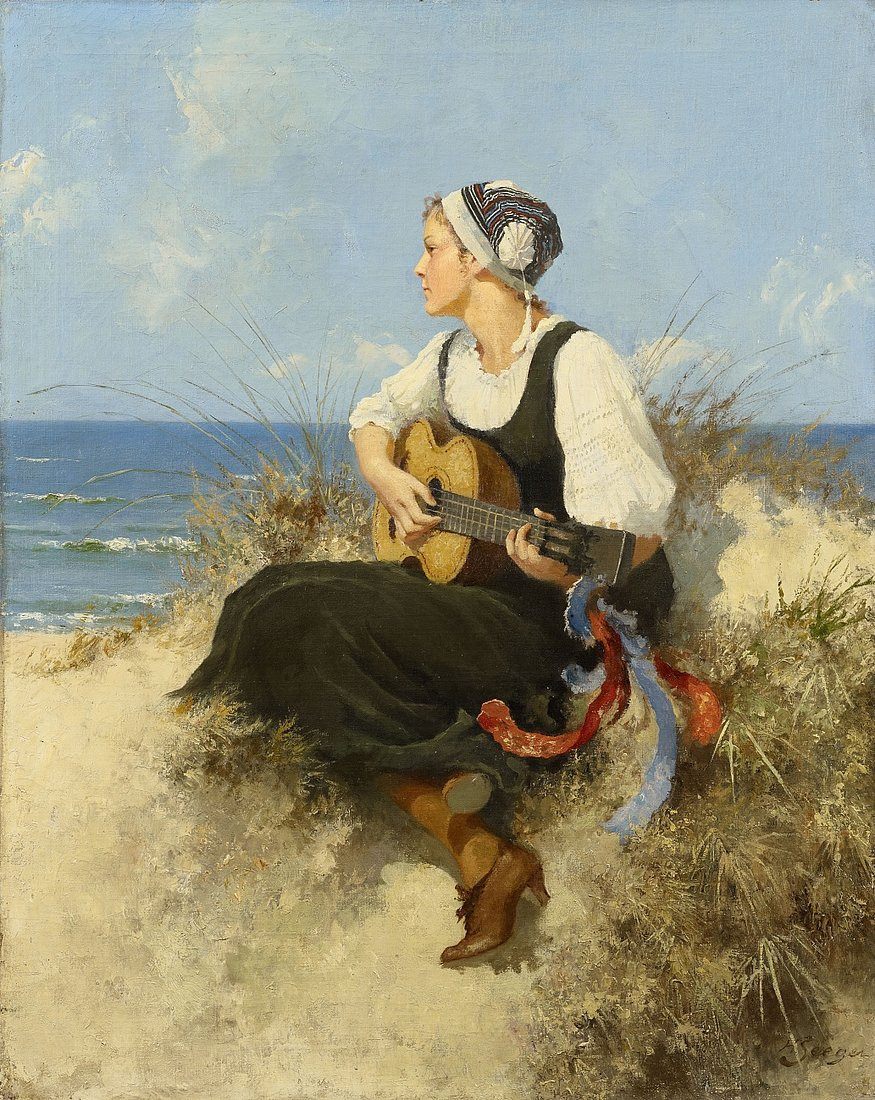
Nothing else known of this poet. Painting by Hermann Seeger.

Translation: Copyright © Timothy Adès
More poems by Otto Reinhards...

Frost

Le givre

Maurice Carême (1899-1978)

Le givre
Mon Dieu ! Comme ils sont beaux Les tremblants animaux Que le givre a fait naître La nuit sur ma fenêtre Ils broutent des fougères Dans un bois plein d’étoiles, Et l’on voit la lumière A travers leurs corps pâles. Il y a un chevreuil Qui me connaît déjà ; Il soulève pour moi Son front d’entre les feuilles. Et quand il me regarde, Ses grands yeux sont si doux Que je sens mon cœur battre Et trembler mes genoux. Laissez moi, ô décembre ! Ce chevreuil merveilleux. Je resterai sans feu Dans ma petite chambre.
Frost
Dear God, the splendours That frost engenders On my pane, the features Of trembling creatures! They’re feeding on ferns In forests of stars; Through their pale forms The daylight appears. A young roe deer knows me He knows me, now, He raises his brow In the leaves, and shows me. He sees me, he sees With his great soft eyes! My heart’s hackles rise, I shake at the knees. Leave me, December, This wonderful deer! I’ll light no fire In my little chamber.

Translation: Copyright © Timothy Adès
More poems by Maurice Carême...

Autumn

L'automne

Maurice Carême (1899-1978)

L'automne
L’automne au coin du bois Joue de l’harmonica. Quelle joie chez les feuilles! Elles valsent au bras du vent qui les emporte. On dit qu’elles sont mortes, Mais personne n’y croit. L’automne au coin du bois Joue de l’harmonica. Quelle joie chez les feuilles!
Autumn
Autumn plays on his mouth-organ in woodland ways. They love it, the leaves! Away they waltz on the arm of the breeze. Someone said they are dead which no-one believes. Autumn plays on his mouth-organ in woodland ways. They love it, the leaves!

Translation: Copyright © Timothy Adès

More poems by Maurice Carême...

May

Der Mai

Erich Kästner (1899-1974)

Der Mai
Im Galarock des heiteren Verschwenders, ein Blumenzepter in der schmalen Hand, fährt nun der Mai, der Mozart des Kalenders, aus seiner Kutsche grüßend, über Land. Es überblüht sich, er braucht nur zu winken. Er winkt! Und rollt durch einen Farbenhain. Blaumeisen flattern ihm voraus und Finken. Und Pfauenaugen flügeln hinterdrein. Die Apfelbäume hinterm Zaun erröten. Die Birken machen einen grünen Knicks. Die Drosseln spielen, auf ganz kleinen Flöten, das Scherzo aus der Symphonie des Glücks. Die Kutsche rollt durch atmende Pastelle. Wir ziehn den Hut. Die Kutsche rollt vorbei. Die Zeit versinkt in einer Fliederwelle. O, gäb es doch ein Jahr aus lauter Mai! Melancholie und Freude sind wohl Schwestern. Und aus den Zweigen fällt verblühter Schnee. Mit jedem Pulsschlag wird aus Heute Gestern. Auch Glück kann weh tun. Auch der Mai tut weh. Er nickt uns zu und ruft: „Ich komm ja wieder!“ Aus Himmelblau wird langsam Abendgold. Er grüßt die Hügel, und er winkt dem Flieder. Er lächelt. Lächelt. Und die Kutsche rollt.
May
GLAD RAGS adorn this big and merry spender; A flower sceptre fills his gentle hand. This Mozart of (in German) the ‘KaLENder’ Spreads greetings from his coach across the land. A glut of blooms! He waves, that’s all he’s needing: He waves, and rolls through groves of every hue, Fluttering finches, bluetits too, preceding, Then peacock butterflies: his retinue. Green birch-trees dip their boughs and bow and curtsey, Apple-trees at the fence blush tints of rose. A Scherzo penned by Bliss, with other Scherzi, Is played by thrushes on their piccolos. This art’s alive and breathing, beyond lifelike: We raise our hat. The coach rolls on its way. Time is sucked under in a wave of lilac. O for a year of nothing else but May! Melancholy and ecstasy are sisters, And faded blossoms fall from boughs, like snow. Each heartbeat fashions yesterdays from this-days. And happiness can hurt. May too, you know. ‘I’m back! I’m here!’ he cries. He’s welcoming us! The gold of eve replaces heaven’s blue. He greets the hills, he nods to the syringas, He smiles and smiles. The coach goes rolling through.

Translation: Copyright © Timothy Adès

More poems by Erich Kästner...

All Things Pass

Vergänglichkeit

Hermann Hesse (1877-1962)

Vergänglichkeit
Vom Baum des Lebens fällt mir Blatt um Blatt, O taumelbunte Welt, wie machst du satt, wie machst du satt und müd, wie machst du trunken! Was heut noch glüht, ist bald versunken. Bald klirrt der Wind über mein braunes Grab, über das kleine Kind beugt sich die Mutter herab. Ihre Augen will ich wiedersehn, ihr Blick ist mein Stern, alles andre mag gehn und verwehn, alles stirbt, alles stirbt gern. Nur die ewige Mutter bleibt, von der wir kamen, ihr spielender Finger schreibt in die flüchtige Luft unsre Namen.
All Things Pass
Leaf after leaf, from life's tree, fall. Bright whirling world, you cloy, you pall. You pall and you tire, You make us drunken! Today's glowing fire Will soon be sunken. At my brown grave The wind shall blow; Over the babe Mother bends low. May my star be bright, The glance of her eyes! On all else be blight! All readily dies. The great Mother stays, From whom we came: On the winds she plays, As she scrawls our name.

Translation: Copyright © Timothy Adès

More poems by Hermann Hesse...

Early Spring

Vorfrühling

Rainer Maria Rilke (1875-1926)

Vorfrühling
Härte schwand. Auf einmal legt sich Schonung an der Wiesen aufgedecktes Grau. Kleine Wasser ändern die Betonung. Zärtlichkeiten, ungenau, greifen nach der Erde aus dem Raum. Wege gehen weit ins Land und zeigens. Unvermutet siehst du seines Steigens Ausdruck in dem leeren Baum.
Early Spring
Stiffness, gone. And now a softness settles on the fields’ grey cover. Little streams try out new noises. Indeterminate caresses reach for Earth from somewhere over. Lanes run clear across the land. Spring is suddenly at hand: on the bare tree, see its traces.

Translation: Copyright © Timothy Adès

More poems by Rainer Maria Rilke...

The Wind’s a Whistler

Es pfeift der Wind . . .

Christian Morgenstern (1871-1914)

Es pfeift der Wind . . .
Es pfeift der Wind. Was pfeift er wohl? Eine tolle, närrische Weise. Er pfeift auf einem Schlüssel hohl, bald gellend und bald leise. Die Nacht weint ihm den Takt dazu mit schweren Regentropfen, die an der Fenster schwarze Ruh ohn End eintönig klopfen. Es pfeift der Wind. Es stöhnt und gellt. Die Hunde heulen im Hofe. Er pfeift auf diese ganze Welt, der große Philosophe.
The Wind’s a Whistler
The wind’s a whistler. His will be a melody mad and mental, all in a single dismal key, now bellowing, now gentle. Night weeps the pulse that he maintains, sends heavy raindrops pounding on the black peaceful window-panes, relentlessly resounding. A roaring, groaning sibilant, In all the world he’ll whistle. Let yard-dogs rant: he’s Newton, Kant, Socrates, Bertrand Russell.

Translation: Copyright © Timothy Adès

More poems by Christian Morgenstern...

The Willow Catkin

Das Weidenkätzchen

Christian Morgenstern (1871-1914)

Das Weidenkätzchen
Kätzchen ihr der Weide, wie aus grauer Seide, wie aus grauem Samt! O ihr Silberkätzchen, sagt mir doch, ihr Schätzchen, sagt, woher ihr stammt. Wollen's gern dir sagen: Wir sind ausgeschlagen aus dem Weidenbaum, haben winterüber drin geschlafen, Lieber, in tieftiefem Traum. In dem dürren Baume in tieftiefem Traume habt geschlafen ihr? In dem Holz, dem harten war, ihr weichen, zarten, euer Nachtquartier? Mußt dich recht besinnen: Was da träumte drinnen, waren wir noch nicht, wie wir jetzt im Kleide blühn von Samt und Seide hell im Sonnenlicht. Nur als wie Gedanken lagen wir im schlanken grauen Baumgeäst; unsichtbare Geister, die der Weltbaumeister dort verweilen lässt. Kätzchen ihr der Weide, wie aus grauer Seide, wie aus grauem Samt! O ihr Silberkätzchen, ja, nun weiß, ihr Schätzchen, ich, woher ihr stammt.  
The Willow Catkin
You catkins of willow, silk-grey, velvet-grey, silver catkins, o say: my sweetings, o tell me, how came you this way? We’ll happily say: the willow’s our home, and from it we come; we slept winter away, deep, deep was our dream. In bare trees to sleep, and dreaming so deep? You are tender! How could that be? Was it good, hard night in the wood? Consider aright: we dreamed in the glade, not yet so arrayed as now we’re displayed, silk, velvet, grey shade, by sun shining bright. Like pure meditation in bare boughs we lay, boughs narrow and grey, unseen inspiration: the Lord of creation allowed us to stay. You catkins of willow, silk-grey, velvet-grey, silver catkins, I pay respects to you, sweetings: you’ve told me the way you came here, today.

Translation: Copyright © Timothy Adès

More poems by Christian Morgenstern...