Les Rois

The Kings

Émile Verhaeren (1855-1916)

The Kings
C’est une troupe de gamins Qui porte la virevoltante étoile De toile Au bout d’un baton vain. Le vieux maître d’école Leur a donné congé; L’hiver est blanc, la neige vole, Le bord du toit en est frangé. Et par les cours, et par les rues, Et deux par deux, et trois par trois, Ils vont chantant avec des voix Qui muent, Tantôt grêles, tantôt fortes, De porte en porte, La complainte du jour des Rois. « Avec leurs cœurs, avec leurs vœux, Toquets de vair, souliers de plumes, Collets de soie et longs cheveux, Et blancs comme est blanche l’écume, Faldera, falderie, Vierge Marie, Voici venir, sur leurs grands palefrois, Les bons mages qui sont des rois. » « Avec leurs cœurs, avec leurs vœux, Jambes rêches, tignasses rousses, Vêtement lâche en peaux de bœufs, Mais doux comme est douce la mousse Faldera, falderie, Vierge Marie, Voici venir, avec troupeaux et chiens Les vieux bergers qui ne sont rien. » « Avec leurs cœurs, avec leurs vœux, Sabots rouges, casquettes brunes, Mentons gercés et nez morveux Et froids comme est froide la lune Faldera, falderie, Vierge Marie, Voici venir, au sortir de l’école Ceux qui demandent une obole. » Et sur le seuil des torpides maisons, Non pas à flots, ni à foisons, Mais revêches et rarissimes, Comme si le cuivre craignait le froid, Sont égrenés, du bout des doigts, Les minimes centimes. Les gamins crient, Et remercient, Happent l’argent qui leur échoit; Et chacun d’eux, à tour de role, Et sur le front, et sur le torse, et les épaules Se trace, avec le sou, le signe de la croix.
Les Rois
An urchin troupe Waves the twirling star Of cloth at the top Of a lofty prop. Old schoolmaster grants A half-day off. Winter’s white, flakes dance, Snow fringes the roof. In courts and streets By twos and threes From door to door they sing With breaking voices hoarse or strong This day’s own ballad of the Kings. “With heartfelt goodwill-vows, Topknots of ermine, plumes on shoes, Silk collars, tresses, here we come, As pale as foam, Fal-lal, fal-lairy, Virgin Mary, On our high palfreys journeying, We kindly Wise Men, each a king.” “With heartfelt goodwill-vows And shaggy legs and russet wigs And shabby garb of hides of cows As soft as moss, Fal-lal, fal-lairy, Virgin Mary, Here we come with flocks and dogs, We the old shepherds, merest dross.” “With heartfelt goodwill-vows, Chins chapped, snot-nosed, Brown-capped, red clogs, Cold as the moon, Fal-lal, fal-lairy, Virgin Mary, Here we come from schoolroom door, For an obol, only a coin, no more.” And on the thresholds Of torpid households Not streaming, teeming But crabbed and sparse, – Perhaps the brass Shrinks from the cold? – Cold hands dispense Mean sous and cents. Urchins cry thanks, Snatch the sum thrown, And each in turn On brow, breast, shoulders with the coin Traces the cross.

Translation: Copyright © Timothy Adès

More poems by Émile Verhaeren...

Épiphanie

Epiphany

José-Maria de Hérédia (1842-1905)

Epiphany
Donc, Balthazar, Melchior et Gaspar, les Rois Mages, Chargés de nefs d’argent, de vermeil et d’émaux Et suivis d’un très long cortège de chameaux, S’avancent, tels qu’ils sont dans les vieilles images. De l’Orient, lointain, ils portent leurs hommages Aux pieds du fils de Dieu, nés pour guérir les maux Que souffrent ici-bas l’homme et les animaux ; Un page noir soutient leurs robes à ramages. Sur le seuil de l’étable où veille saint Joseph, Ils ôtent humblement la couronne du chef Pour saluer l’Enfant qui rit et les admire. C’est ainsi qu’autrefois, sous Auguste César, Sont venus, présentant l’or, l’encens et la myrrhe, Les Rois Mages Gaspar, Melchior et Balthazar.
Épiphanie
Balthazar, Melchior, Caspar, the Three Kings, Loaded with silver, scarlets and enamels, And followed by a long parade of camels, Draw near, as in great art’s imaginings. From eastern lands afar the trio brings Homage to God’s Son, born to heal all ills Endured on earth by men and animals… Intricate robes! held high by underlings. St Joseph keeps his vigil at the byre: They humbly doff their crowns, their heads are bare, They greet the laughing and admiring Child. So, when in times long past Augustus ruled, There came with myrrh and frankincense and gold Three Kings called Caspar, Melchior, Balthazar.

Translation: Copyright © Timothy Adès

More poems by José-Maria de Hérédia...

Good King Wenceslas

Categories
Latin

Good King Wenceslas

J M Neale

Translated into Latin by Timothy Adès
Good King Wenceslas looked out On the feast of Stephen When the snow lay round about Deep and crisp and even Brightly shone the moon that night Though the frost was cruel When a poor man came in sight Gath'ring winter fuel "Hither, page, and stand by me If thou know'st it, telling If thou know'st it, telling Yonder peasant, who is he? Where and what his dwelling?" "Sire, he lives a good league hence Underneath the mountain Right against the forest fence By Saint Agnes' fountain." "Bring me flesh and bring me wine Bring me pine logs hither Thou and I will see him dine When we bear him thither." Page and monarch forth they went Forth they went together Through the rude wind's wild lament And the bitter weather "Sire, the night is darker now And the wind blows stronger Fails my heart, I know not how, I can go no longer." "Mark my footsteps, my good page Tread thou in them boldly Thou shalt find the winter's rage Freeze thy blood less coldly." In his master's steps he trod Where the snow lay dinted Heat was in the very sod Which the Saint had printed Therefore, Christian men, be sure Wealth or rank possessing Ye who now will bless the poor Shall yourselves find blessing.
Good King Wenceslas
Wenceslaë, quas nives     prospicis, rex pie, crusta plana stabiles     Stephani in die! lunae lux trans tenebras     monstrat indigentem per pruinas horridas     ligna colligentem.   “Adsta, puer, propius,     narrans forsan testis: unde venit, quae domus,     quis est hic agrestis?” “Tria procul milia     redit hinc sub montem, silvae saepis incola     Agnes iuxta fontem.”   “Fer mi carnem, vinum fer,     pineis cum lignis: hunc visemus, minister,     dapibus benignis.” rex et puer protinus     una properatis, duris in frigoribus     raucae tempestatis.   “Princeps, nox fit caecior,     aquilo bacchatur. nescio quam languet cor:     progredi non datur.” “Vade passibus meis     sanguine tepenti, trucis expers hiemis,     vi non algens venti.”   Calcat passus domini     per nives ingressi: caespites sunt calidi     sancto pede pressi. ergo, potens vel dives,     credas et salveris! benedicens pauperes     tu benediceris.

Translation: Copyright © Timothy Adès

More poems by J M Neale...

A Dream of Christmas

Emmanuel : Un Rêve de Noël

Charles-Marie Leconte de Lisle (1818-94)

Emmanuel : Un Rêve de Noël
…Par les noirs tourbillons de l’ombre j’ai gravi Les trois sphères du ciel où saint Paul fut ravi; Et, de là, regardant, au travers des nuées, Les cimes de la terre en bas diminuées, J’ai vu, par l’œil perçant de cette vision, L’empire d’Augustus et l’antique Sion; Et, dans l’immense nuit de ces temps, nuit épaisse Où s’ensevelissait toute l’humaine espèce Comme un agonisant qui hurle en son linceul, J’ai vu luire un rayon éblouissant, un seul! Et c’était, entre l’âne et le boeuf à leur crèche, Un enfant nouveau-né sur la paille fraîche: Chair neuve, âme sans tache, et, dans leur pureté, Étant comme un arôme et comme une clarté ! Le père à barbe grise et la Mère joyeuse Saluaient dans leur coeur cette aube radieuse, Ce matin d’innocence après la vieille nuit, Apaisant ce qui gronde et charmant ce qui nuit; Cette lumière à peine éclose et d’où ruisselle L’impérissable vie avec chaque étincelle! Et les bergers tendaient la tête pour mieux voir; Et j’ai soudainement ouï par le ciel noir, Tandis que les rumeurs d’en bas semblaient se taire, Une voix dont le son s’épandit sur la terre, Mais douce et calme, et qui disait: Emmanoël! Et l’espace et le temps chantaient: Noël! Noël!
A Dream of Christmas
Through swirling mists and eddying gloom I scaled three spheres of heaven whence St Paul was haled; across the clouds I saw in distant show Earth and her peaks diminished far below: with mystic piercing eye I did behold Augustus’ empery and Sion of old; and in that age’s vast obscurity, thick night, that shrouded all humanity like one in cerements who strains to scream, I saw a single shining, dazzling beam! There at the cattle-stall on fragrant hay by ox and ass a new-born infant lay: new flesh and spotless soul, whose purity seemed an aroma and a clarity! The joyful Mother and the father grey opened their hearts to greet this radiant day, innocent morning after age-long night, that charms the hurtful and assuages spite, the streaming light that never can be dark, imperishable life in every spark! And as the shepherds craned their necks to see, through the black sky I heard it suddenly, while all the murmurs from below were stilled: a sounding voice, by which the earth was filled! Gentle and calm, it said, Emmanuel; and Time and Space sang out: Nowell! Nowell!

Translation: Copyright © Timothy Adès

More poems by Charles-Marie Leconte de Lisle...

Birth of Christ, with comment on the Bee.

Nacimiento de Cristo, en que se discurrió la abeja.

Sor Juana de la Cruz (1648-95)

Nacimiento de Cristo, en que se discurrió la abeja.
De la más fragante Rosa nació la Abeja más bella, a quien el limpio rocío dio purísima materia. Nace, pues, y apenas nace, cuando en la misma moneda, lo que en perlas recibió, empieza a pagar en perlas. Que llore el Alba, no es mucho, que es costumbre en su belleza; mas ¿quién hay que no se admire de que el Sol lágrimas vierta? Si es por fecundar la Rosa, es ociosa diligencia, pues no es menester rocío después de nacer la Abeja; y más, cuando en la clausura de su virginal pureza, ni antecedente haber pudo ni puede haber quien suceda. Pues a ¿qué fin es el llanto que dulcemente le riega? Quien no puede dar más Fruto, ¿qué importa que estéril sea? Mas ¡ay! que la Abeja tiene tan íntima dependencia siempre con la Rosa, que depende su vida de ella; pues dándole el néctar puro que sus fragancias engendran, no sólo antes la concibe, pero después la alimenta. Hijo y madre, en tan divinas peregrinas competencias, ninguno queda deudor y ambos obligados quedan. La Abeja paga el rocío de que la Rosa la engendra, y ella vuelve a retornarle con lo mismo que la alienta. Ayudando el uno al otro con mutua correspondencia, la Abeja a la Flor fecunda, y ella a la Abeja sustenta. Pues si por eso es el llanto, llore Jesús, norabuena, que lo que expende en rocío cobrará después en néctar.
Birth of Christ, with comment on the Bee.
From the sweet-scented Rose is born the lovely Bee, to whom the bright dew gave its essence and purity. No sooner is he born than in the same currency what he received in pearls in pearls he starts to repay. If the Dawn weeps, that’s nothing, just its habit, being beautiful; but that the Sun sheds tears, don’t we all find it incredible? If it’s to water the Rose, that’s a tender care forlorn, for there’s no need of dew after the Bee is born; he is intact in his purity like a nun in a cloister: he had no predecessor and can have no successor. Then what good is the weeping that gently plies him with water? He can bear no more Fruit and is barren, but does that matter? But oh! the Bee relies for his life on her, the Rose: his dependence is always so intimate and close: for by giving him pure nectar that her sweet scents deliver, she gives him life, conceives him, and feeds him too, thereafter. Mother and son, in such sacred and wondrous obligations, neither is left indebted and both of them are grateful. He pays her for the dew, the Bee whom the Rose conceives: and she gives him in return the same food she receives. Giving aid to one another in mutual symmetry, the Bee enriches the Flower and the Flower sustains the bee. If that is the cause of weeping, weep, Jesus, and best of luck! whatever you spend in dew, in nectar you’ll reap it back.
Published in 'A Very Mexican Christmas', New Vessels Press, New York.

Translation: Copyright © Timothy Adès

More poems by Sor Juana de la Cruz...

Shepherd of Pearls

Zagalejo de Perlas

Lope de Vega (1562-1635)

Zagalejo de Perlas
Zagalejo de perlas, hijo del Alba, ¿dónde vais que hace frío tan de mañana? Como sois lucero del alma mía, al traer el día nacéis primero; pastor y cordero sin choza y lana, ¿dónde vais que hace frío tan de mañana? Perlas en los ojos, risa en la boca, las almas provoca a placer y enojos; cabellitos rojos, boca de grana, ¿dónde vais que hace frío tan de mañana? Que tenéis que hacer, pastorcito santo, madrugando tanto lo dais a entender; aunque vais a ver disfrazado el alma, ¿dónde vais que hace frío tan de mañana?
Shepherd of Pearls
Shepherd of pearls, child of the Dawn, where must you go this cold early morn? Light of my soul, star of the morn, you bring the day, you the first-born. Shepherd and sheep, shelterless, shorn, where must you go this cold early morn? Eyes full of pearls, lips full of joy, teaser of souls, soothe or annoy: Ruby-child, blow, rose-lip, your horn: where must you go this cold early morn? What must you do, saint of the sheep, honest and true, world still asleep? Cloak of the soul, lowliness worn, where must you go this cold early morn?

Translation: Copyright © Timothy Adès

More poems by Lope de Vega...

Four Forks in a Square

Quatre fourches en carré

Nicolas Denisot – ‘Conte d’Alsinois’ (1515-59)

Quatre fourches en carré
Quatre fourches en carré, L'une sur l'autres penchantes, Sous un plancher bigarré, De tous côtés chancelantes, Étayent les quatre piliers De ce si tant beau repaire, Où les anges à milliers Ont vu la Vierge être mère. Tout le plancher de roseaux Et de paille ramassée, De torchis et de tuileaux, D'herbe sèche entrelacée, Était tout entièrement Lambrissé en telle sorte, Qu'on eût dit facilement Le tout n'être qu'une porte. Le froid, l'humide et le chaud, L'éclair, l'horreur, le tonnerre, Bref, ce qui tombe d'en haut Sur les sillons de la terre, Pouvaient tomber en ce lieu, En ce lieu sans couverture Qui a vu l'enfant de Dieu Naître d'une créature.
Four Forks in a Square
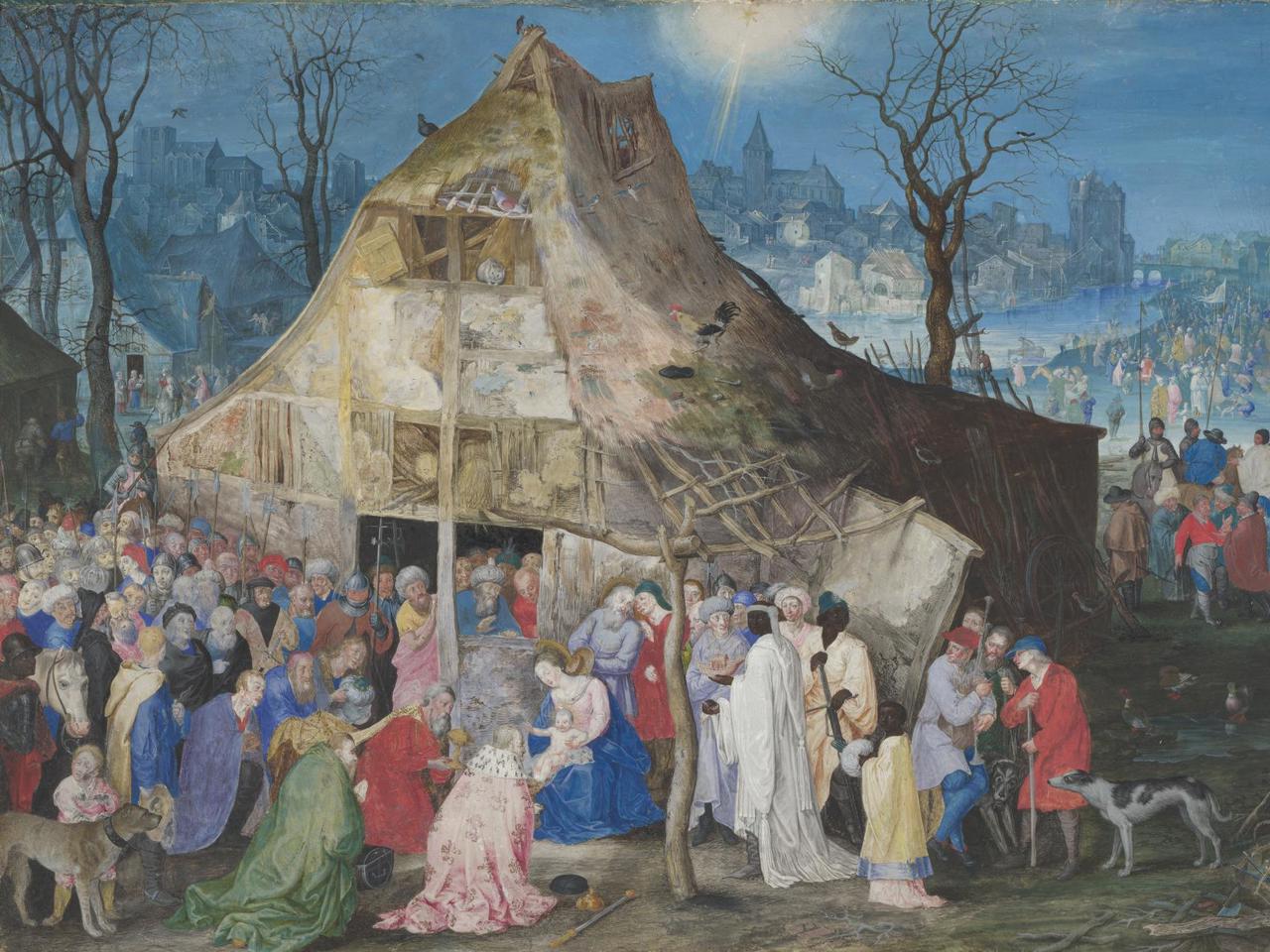
...Four forks in a square leaned on one another, propping up a patchwork layer, tottering together: these were pillars four of the fine abode where ten thousand angels saw Virgin motherhood. All of straw the strewing and of gathered rushes, smear of daub and broken tiling, weave of withered grasses: so it was devised, you would say for sure all that handiwork comprised but an open door… Thunder flashing bright, fog and heat and cold, all that falls from airy height on the furrowed field, so much could intrude on this roofless room, that beheld the child of God born of mortal womb.
Painting by Jan Brueghel the Elder, National Gallery, London

Translation: Copyright © Timothy Adès

More poems by Nicolas Denisot – ‘Conte d’Alsinois’...