Venice -The Little Boat
Venezia - La Barcheta
Pietro Burratti (1772-1832)
Venezia - La Barcheta
La note è bela
Fa presto, o Nineta
Andemo in barcheta
I freschi a ciapar!
A Toni g’ho dito
Ch’el felze el ne cave
Per goder sta bava
Che supia dal mar
Ah!
Che gusto contarsela
Soleti in laguna
E al chiaro de luna
Sentirse a vogar!
Ti pol de la ventola
Far senza, o mia cara
Chè zefiri a gara
Te vol sventolar
Ah!
Se gh’è tra de lori
Chi tropo indiscreto
Volesse dal pèto
EI velo strapar
No bada a ste frotole
Soleti za semo
E Toni el so’ remo
Lè a tento a menar
Ah!
Venice -The Little Boat
It’s a beautiful night
Come quickly Ninetta
Let’s go in the boat
To take the fresh air.
I have told Toni
To row to the cave:
We’ll rejoice in the breezes
Blown in from the wave.
Ah!
What joy to describe it!
Alone, the lagoon,
The sound of his rowing,
The light of the moon.
And as for your fan,
No need of it here:
The zephyrs will hasten
To fan you, my dear.
Ah!
If there is among them
One too indiscreet
Who’d wish from your bosom
The cover to tear,
Don’t heed such tall tales,
We’re alone, no-one’s there,
And Toni our oarsman
Shall guide us with care.
Ah!
Translation: Copyright © Timothy Adès
More poems by Pietro Burratti...
The Gods of Greece
Die Götter Griechenlands
Friedrich von Schiller (1759-1805)
Die Götter Griechenlands
Schöne Welt, wo bist du? Kehre wieder
Holdes Blütenalter der Natur!
Ach, nur in dem Feenland der Lieder
Lebt noch deine fabelhafte Spur.
Ausgestorben trauert das Gefilde,
Keine Gottheit zeigt sich meinem Blick,
Ach, von jenem lebenwarmen Bilde
Blieb der Schatten nur zurück.
The Gods of Greece
Most beauteous world, where may you be?
Nature’s bright springtime, come again!
Only in fairy minstrelsy
Your storied memories remain.
The field has faded and is keening,
No god reveals to me his form:
Only the shadow still remaining,
The vision once alive and warm.
Translation: Copyright © Timothy Adès
More poems by Friedrich von Schiller...
Birth of Christ, with comment on the Bee.
Nacimiento de Cristo, en que se discurrió la abeja.
Sor Juana de la Cruz (1648-95)
Nacimiento de Cristo, en que se discurrió la abeja.
De la más fragante Rosa
nació la Abeja más bella,
a quien el limpio rocío
dio purísima materia.
Nace, pues, y apenas nace,
cuando en la misma moneda,
lo que en perlas recibió,
empieza a pagar en perlas.
Que llore el Alba, no es mucho,
que es costumbre en su belleza;
mas ¿quién hay que no se admire
de que el Sol lágrimas vierta?
Si es por fecundar la Rosa,
es ociosa diligencia,
pues no es menester rocío
después de nacer la Abeja;
y más, cuando en la clausura
de su virginal pureza,
ni antecedente haber pudo
ni puede haber quien suceda.
Pues a ¿qué fin es el llanto
que dulcemente le riega?
Quien no puede dar más Fruto,
¿qué importa que estéril sea?
Mas ¡ay! que la Abeja tiene
tan íntima dependencia
siempre con la Rosa, que
depende su vida de ella;
pues dándole el néctar puro
que sus fragancias engendran,
no sólo antes la concibe,
pero después la alimenta.
Hijo y madre, en tan divinas
peregrinas competencias,
ninguno queda deudor
y ambos obligados quedan.
La Abeja paga el rocío
de que la Rosa la engendra,
y ella vuelve a retornarle
con lo mismo que la alienta.
Ayudando el uno al otro
con mutua correspondencia,
la Abeja a la Flor fecunda,
y ella a la Abeja sustenta.
Pues si por eso es el llanto,
llore Jesús, norabuena,
que lo que expende en rocío
cobrará después en néctar.
Birth of Christ, with comment on the Bee.
From the sweet-scented Rose
is born the lovely Bee,
to whom the bright dew gave
its essence and purity.
No sooner is he born
than in the same currency
what he received in pearls
in pearls he starts to repay.
If the Dawn weeps, that’s nothing,
just its habit, being beautiful;
but that the Sun sheds tears,
don’t we all find it incredible?
If it’s to water the Rose,
that’s a tender care forlorn,
for there’s no need of dew
after the Bee is born;
he is intact in his purity
like a nun in a cloister:
he had no predecessor
and can have no successor.
Then what good is the weeping
that gently plies him with water?
He can bear no more Fruit
and is barren, but does that matter?
But oh! the Bee relies
for his life on her, the Rose:
his dependence is always
so intimate and close:
for by giving him pure nectar
that her sweet scents deliver,
she gives him life, conceives him,
and feeds him too, thereafter.
Mother and son, in such sacred
and wondrous obligations,
neither is left indebted
and both of them are grateful.
He pays her for the dew,
the Bee whom the Rose conceives:
and she gives him in return
the same food she receives.
Giving aid to one another
in mutual symmetry,
the Bee enriches the Flower
and the Flower sustains the bee.
If that is the cause of weeping,
weep, Jesus, and best of luck!
whatever you spend in dew,
in nectar you’ll reap it back.
Translation: Copyright © Timothy Adès
More poems by Sor Juana de la Cruz...
Song
Chanson
Pierre Corneille (1606-84)
Chanson
Si je perds bien des maîtresses,
J’en fais encor plus souvent,
Et mes voeux et mes promesses
Ne sont que feintes caresses,
Et mes voeux et mes promesses
Ne sont jamais que du vent.
Quand je vois un beau visage,
Soudain je me fais de feu,
Mais longtemps lui faire hommage,
Ce n’est pas bien mon usage,
Mais longtemps lui faire hommage,
Ce n’est pas bien là mon jeu.
J’entre bien en complaisance
Tant que dure une heure ou deux,
Mais en perdant sa présence
Adieu toute souvenance,
Mais en perdant sa présence
Adieu soudain tous mes feux.
Plus inconstant que la lune
Je ne veux jamais d’arrêt;
La blonde comme la brune
En moins de rien m’importune,
La blonde comme la brune
En moins de rien me déplaît.
Si je feins un peu de braise,
Alors que l’humeur m’en prend,
Qu’on me chasse ou qu’on me baise,
Qu’on soit facile ou mauvaise,
Qu’on me chasse ou qu’on me baise,
Tout m’est fort indifférent.
Mon usage est si commode,
On le trouve si charmant,
Que qui ne suit ma méthode
N’est pas bien homme à la mode,
Que qui ne suit ma méthode
Passe pour un Allemand.
Song
I lose many mistresses,
Gain more, to spare.
My vows and my promises,
Kisses, just ruses:
My vows and my promises,
Wind, light as air.
I see a sweet visage,
I’m quickly aflame
But drawing out homage
Just isn’t my usage,
But drawing out homage
Just isn’t my game.
I’ll join in complaisance
For one or two hours,
But losing her presence
It’s bye-bye remembrance,
But losing her presence,
Farewell all my fires.
I’m a moon of no constance,
I don’t stop or stall,
Brunettance or blondance
I feel no repugnance,
Brunettance or blondance,
Reluctance, at all.
I act a bit steamy
When feeling inclined:
They shoo me or woo me,
Turn dreadful or dreamy,
They shoo me or woo me,
I simply don’t mind.
So neat is my custom
They all find it charming.
You don't do my system?
You’ve no savoir faire, man!
You don't do my system?
You’d pass for a German.
Translation: Copyright © Timothy Adès
More poems by Pierre Corneille...
Sonnet XIV
Sonnet XIV
Louise Labé (1524-66)
Sonnet XIV
Tant que mes yeux pourront larmes épandre
A l’heur passé avec toi regretter :
Et qu’aux sanglots et soupirs résister
Pourra ma voix, et un peu faire entendre :
Tant que ma main pourra les cordes tendre
Du mignard Luth, pour tes grâces chanter :
Tant que l’esprit se voudra contenter
De ne vouloir rien fors que toi comprendre :
Je ne souhaite encore point mourir.
Mais quand mes yeux je sentirai tarir,
Ma voix cassée, et ma main impuissante,
Et mon esprit en ce mortel séjour
Ne pouvant plus montrer signe d’amante :
Prierai la mort noircir mon plus clair jour.
Sonnet XIV
As long as I can sit with streaming eyes
And want to spend another hour with you;
As long as I can stifle sobs and sighs
And use my voice to get a message through;
As long as I’ve a hand can tune the strings
Of my guitar, to sing a song of you;
As long as I’ve no heart for other things
But only want to get the hang of you:
There’s no way I’ll be lying down to die.
No, but the day I feel my eyes run dry,
My voice crack up, my hand with zero power,
My heart, too close to earth, no longer giving
Signals that lovers give: then, I’ll quit living…
Death, turn my daylight black, that very hour!
Translation: Copyright © Timothy Adès
More poems by Louise Labé...
Mother of Arts
France, mère des arts
Joachim du Bellay (1522-60)
France, mère des arts
France, mère des arts, des armes et des lois,
Tu m'as nourri longtemps du lait de ta mamelle :
Ores, comme un agneau qui sa nourrice appelle,
Je remplis de ton nom les antres et les bois.
Si tu m'as pour enfant avoué quelquefois,
Que ne me réponds-tu maintenant, ô cruelle ?
France, France, réponds à ma triste querelle.
Mais nul, sinon Écho, ne répond à ma voix.
Entre les loups cruels j'erre parmi la plaine,
Je sens venir l'hiver, de qui la froide haleine
D'une tremblante horreur fait hérisser ma peau.
Las, tes autres agneaux n'ont faute de pâture,
Ils ne craignent le loup, le vent ni la froidure :
Si ne suis-je pourtant le pire du troupeau.
Mother of Arts
Mother of arts and arms and laws,
You’ve suckled me so long, my France.
Now like a lamb who calls his nurse
I cry your name through caves and glens.
Have you not sometimes called me Child?
Then why no answer, cruel France?
My plaint is sad, my wail is wild,
Yet only Echo gives response.
Lost among wolves, I crave the fold:
By winter’s breath I soon am chilled,
Quake in my skin with fear and shock.
Your other lambs are fed and filled,
They fear no wolf, nor wind, nor cold:
Am I the meanest of the flock?
Translation: Copyright © Timothy Adès
More poems by Joachim du Bellay...
You've Come to Rome
Nouveau venu
Joachim du Bellay (1522-60)
Nouveau venu
Nouveau venu, qui cherches Rome en Rome
Et rien de Rome en Rome n'aperçois,
Ces vieux palais, ces vieux arcs que tu vois,
Et ces vieux murs, c'est ce que Rome on nomme.
Vois quel orgueil, quelle ruine : et comme
Celle qui mit le monde sous ses lois,
Pour dompter tout, se dompta quelquefois,
Et devint proie au temps, qui tout consomme.
Rome de Rome est le seul monument,
Et Rome Rome a vaincu seulement.
Le Tibre seul, qui vers la mer s'enfuit,
Reste de Rome. O mondaine inconstance !
Ce qui est ferme, est par le temps détruit,
Et ce qui fuit, au temps fait résistance.
You've Come to Rome
So now you’ve come
To roam in Rome
You see no Rome
In Rome at all
This broken dome
That wilted wall:
They call it Rome.
No more, that’s all.
The pride the fall
Rome had it all
Subdued the world
She ruled by law,
Till downward hurled
In selfish fall
Tamed by time’s maw
That conquers all.
Rome is Rome’s sole
Memorial
Her self-defeat
Is terminal.
Tiber who drains
And runs to sea
Alone remains.
Inconstancy!
What flourishes
Is fallible
What vanishes
Is durable.
Translation: Copyright © Timothy Adès
More poems by Joachim du Bellay...
Sonnets of Virtuous Love - 10
Sonnets de l'honnête amour -10
Joachim du Bellay (1522-60)
Sonnets de l'honnête amour -10
J'ai entassé moi-même tout le bois
Pour allumer cette flamme immortelle,
Par qui mon âme avecques plus haute aile
Se guinde au ciel, d'un égal contrepoids.
Jà mon esprit, jà mon coeur, jà ma voix,
Jà mon amour conçoit forme nouvelle
D'une beauté plus parfaitement belle
Que le fin or épuré par sept fois.
Rien de mortel ma langue plus ne sonne:
Jà peu à peu moi-même j'abandonne
Par cette ardeur, qui me fait sembler tel
Que se montrait l'indompté fils d'Alcmène,
Qui, dédaignant notre figure humaine,
Brûla son corps, pour se rendre immortel.
Sonnets of Virtuous Love - 10
Myself I've heaped the wood up high
to kindle this immortal flame.
My soul on soaring wing shall fly
to heaven, for the weight's the same.
My heart, my voice, my love, my mind,
shall greater comeliness acquire
than gold in seven shifts refined.
I slowly yield me to the fire,
and cease from mortal colloquy.
Like the unconquered god am I,
Alcmena's Hercules, who spurned
our human shape, whose body burned,
who gained his immortality.
Translation: Copyright © Timothy Adès
More poems by Joachim du Bellay...
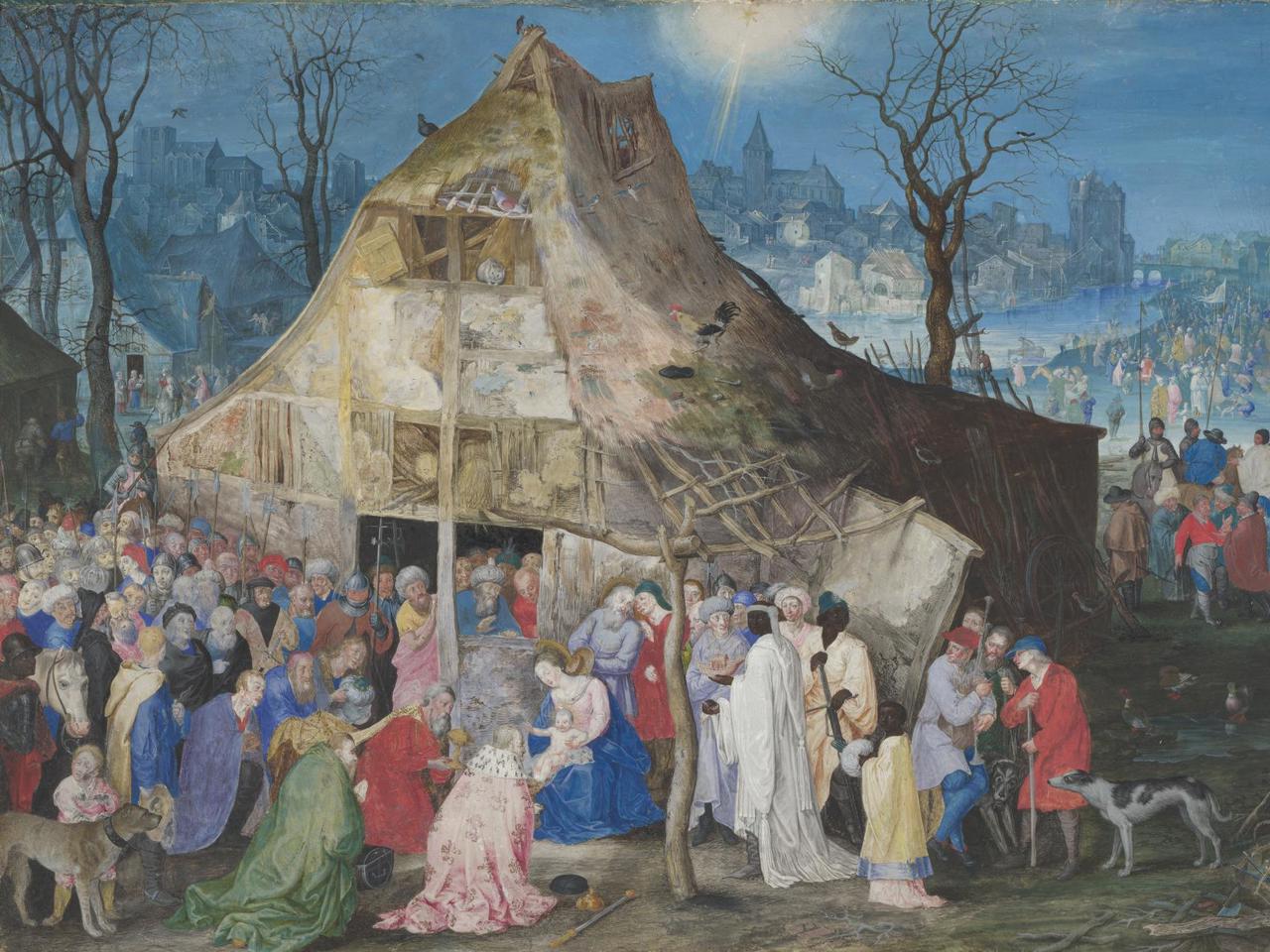
Four Forks in a Square
Quatre fourches en carré
Nicolas Denisot – ‘Conte d’Alsinois’ (1515-59)
Quatre fourches en carré
Quatre fourches en carré,
L'une sur l'autres penchantes,
Sous un plancher bigarré,
De tous côtés chancelantes,
Étayent les quatre piliers
De ce si tant beau repaire,
Où les anges à milliers
Ont vu la Vierge être mère.
Tout le plancher de roseaux
Et de paille ramassée,
De torchis et de tuileaux,
D'herbe sèche entrelacée,
Était tout entièrement
Lambrissé en telle sorte,
Qu'on eût dit facilement
Le tout n'être qu'une porte.
Le froid, l'humide et le chaud,
L'éclair, l'horreur, le tonnerre,
Bref, ce qui tombe d'en haut
Sur les sillons de la terre,
Pouvaient tomber en ce lieu,
En ce lieu sans couverture
Qui a vu l'enfant de Dieu
Naître d'une créature.
Four Forks in a Square
...Four forks in a square
leaned on one another,
propping up a patchwork layer,
tottering together:
these were pillars four
of the fine abode
where ten thousand angels saw
Virgin motherhood.
All of straw the strewing
and of gathered rushes,
smear of daub and broken tiling,
weave of withered grasses:
so it was devised,
you would say for sure
all that handiwork comprised
but an open door…
Thunder flashing bright,
fog and heat and cold,
all that falls from airy height
on the furrowed field,
so much could intrude
on this roofless room,
that beheld the child of God
born of mortal womb.
Translation: Copyright © Timothy Adès
More poems by Nicolas Denisot – ‘Conte d’Alsinois’...